

Pipedrive vs Monday CRM is still one of the most searched CRM comparisons in 2026 — and for good reason.
Both platforms have evolved fast, especially with the rise of AI-powered sales and workflow automation.
When Monday first pushed into the CRM space, reactions were split. Some teams dismissed it as a glorified spreadsheet.
Others embraced its flexible Work OS to run pipelines, automations, and cross-team workflows from one place.
Fast forward to 2026, and the picture is clearer.
Monday CRM has matured into a highly customizable, workflow-driven CRM built on its Work OS foundation.
It shines for teams that want flexibility, visual automation, and collaboration across departments — not just pure sales tracking.
Pipedrive, meanwhile, remains a laser-focused sales CRM.
With over a decade in the market and significant AI upgrades in recent years, Pipedrive continues to dominate among sales-driven teams that want pipeline visibility, deal insights, and guided selling without complexity.
But here’s the uncomfortable truth most buyers learn too late:
👉 Choosing the wrong CRM is often worse than using none at all.
-
-
- Pick a platform that’s too rigid, and your team won’t adopt it.
- Pick one that’s too generic, and your sales pipeline suffers.
- Pick one without the right AI or automation depth in 2026, and you’ll fall behind competitors.
-
Research consistently shows many small businesses regret their software choices — usually because they optimize for features instead of real-world fit.
That’s exactly why this Pipedrive vs Monday CRM (2026) comparison exists.
By the end of this guide, you’ll clearly understand:
-
-
-
The key differences between Monday CRM and Pipedrive
-
Which platform fits your team size and sales motion
-
How their AI capabilities compare in 2026
-
Pricing realities and value for money
-
A strong alternative worth considering
-
-
Let’s get into it.
Table of Contents
TL;DR — Pipedrive vs Monday CRM (2026)
-
-
-
Choose Pipedrive if your priority is sales pipeline management, AI deal insights, and fast adoption for sales reps.
-
Choose Monday CRM if you want a flexible, highly customizable CRM that connects sales with broader team workflows.
-
Big 2026 shift: AI and automation depth now matter more than basic CRM features — and both platforms have improved significantly.
-
-
AI capabilities inside a CRM are becoming increasingly important, but there’s another AI trend many software companies are now paying attention to: whether AI assistants actually recommend their brand when buyers compare products.
An AI Visibility Platform Comparison helps marketing teams evaluate the leading platforms for measuring AI recommendations, citations, competitor visibility, and overall AI search performance across ChatGPT, Claude, Gemini, Perplexity, Copilot, and Google AI Mode.
Pipedrive vs Monday CRM: What’s New in 2026
| Area | Pipedrive (2026) | Monday CRM (2026) |
|---|---|---|
| Core positioning | Sales-focused CRM | Work OS + customizable CRM |
| AI capabilities | AI Sales Assistant, forecasting insights, email AI | AI blocks, workflow automation AI, summaries |
| Best for | Sales-driven teams | Cross-functional teams |
| Customization | Moderate | Very high |
| Ease of adoption | Very easy for sales teams | Moderate learning curve |
| Free plan | No | Yes (up to 2 seats) |
| Automation depth | Sales workflow automation | Visual workflow automation |
| Reporting | Sales forecasting focused | Visual dashboards across teams |
The Key Difference Between Pipedrive and Monday (2026)
So what actually separates Pipedrive vs Monday CRM in 2026? Why do some sales teams swear by Pipedrive while others prefer Monday’s flexibility?
The short answer: focus vs flexibility.
-
-
-
Pipedrive is purpose-built for sales pipeline management and guided selling.
-
Monday CRM is a highly customizable Work OS platform that can be shaped into a CRM.
-
-
Let’s break this down properly.
Pipedrive – Sales-First CRM Built for Revenue Teams
Pipedrive’s core mission hasn’t changed: help sales teams manage pipelines without drowning in clutter. But in 2026, the platform has doubled down on AI-powered selling, automation, and forecasting.
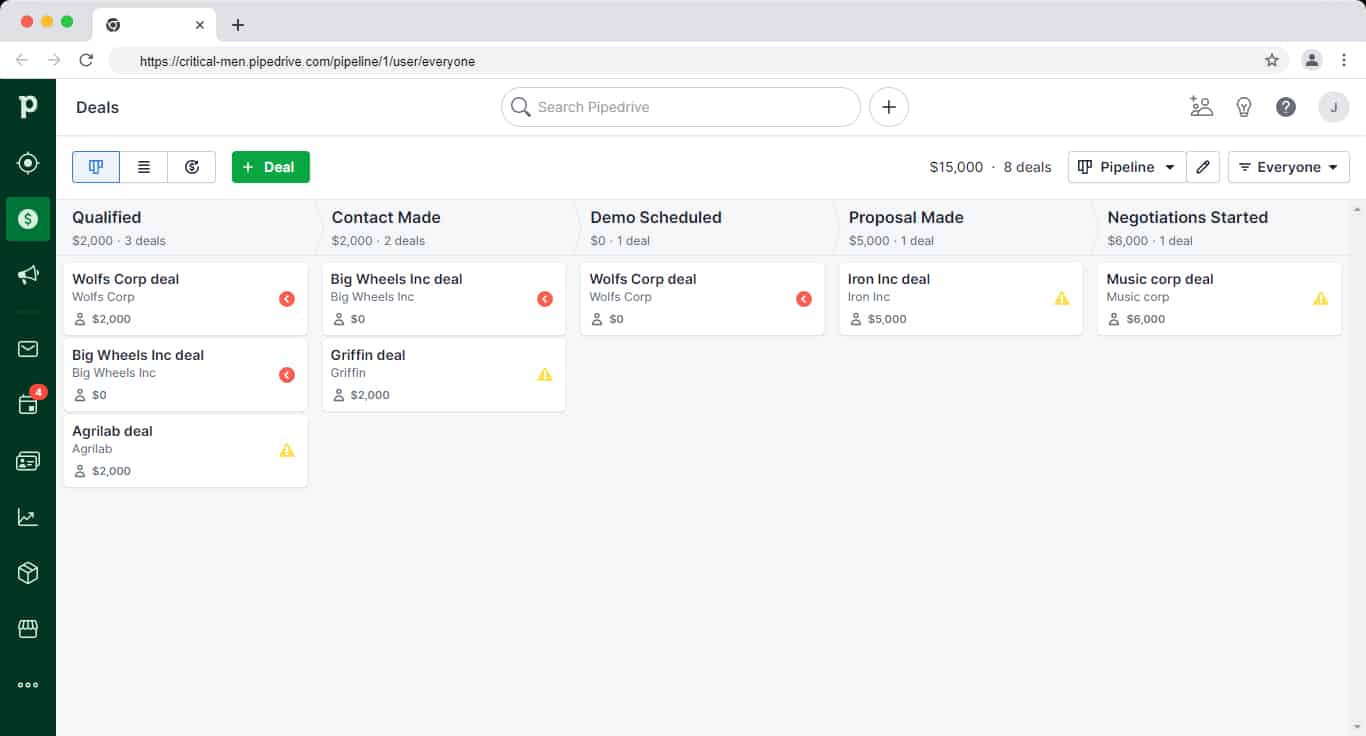
Where Pipedrive stands out is its pipeline-first architecture.
Everything — deals, activities, forecasting, and AI recommendations — revolves around helping reps move opportunities forward faster.
Sales teams especially appreciate:
-
-
-
Clean visual pipelines
-
AI Sales Assistant recommendations
-
Activity-based selling workflows
-
Fast onboarding for reps
-
-
Beyond pipeline management, Pipedrive continues expanding toward full revenue support.
The platform now supports more of the customer lifecycle, including lead capture, nurturing, and post-sale relationship tracking.
As your business scales, Pipedrive positions itself as a sales CRM that grows with your revenue engine, not just a contact database.
Key capabilities include:
-
-
-
LeadBooster to capture and qualify leads
-
Built-in email marketing and tracking
-
AI-powered sales automation to reduce manual work
-
Improved forecasting and reporting for revenue visibility
-
-
👉 Bottom line: Pipedrive is still one of the strongest choices for sales-driven teams that want structure, speed, and AI-guided selling.
Monday – Highly Customizable Work OS With CRM Capabilities
Monday CRM takes a fundamentally different approach.
Instead of starting as a traditional sales CRM, Monday built its CRM on top of its no-code Work OS framework. In 2026, this flexibility remains its biggest strength — and its biggest trade-off.
Teams don’t just get a pipeline tool. They get a system they can mold for:
-
-
-
sales workflows
-
marketing handoffs
-
project delivery
-
cross-team collaboration
-
-
That makes Monday CRM especially attractive for organizations that want one flexible platform across departments.
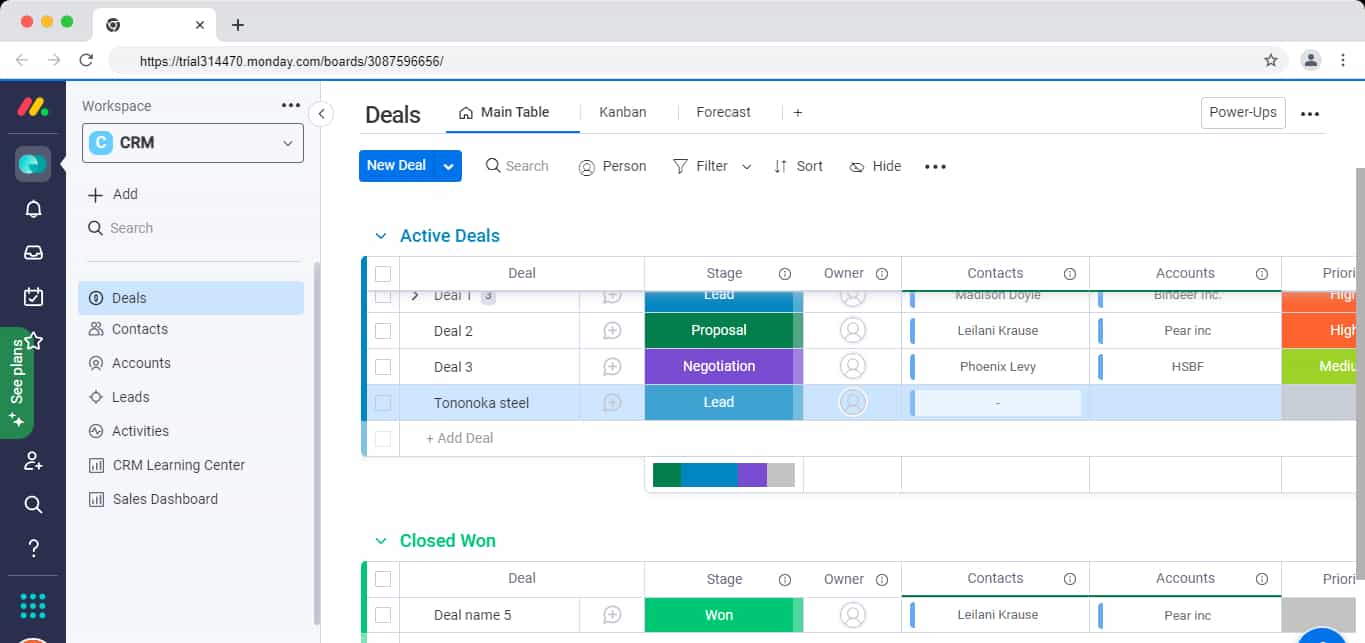
Unlike Pipedrive’s opinionated sales structure, Monday lets you:
-
-
-
Use prebuilt CRM templates
-
Build a pipeline from scratch
-
Create custom automation recipes
-
Add AI workflow blocks and summaries
-
-
Its core CRM capabilities include:
-
-
-
Lead management: Centralized lead capture, qualification, and follow-ups
-
Contact management: Unified interaction history across teams
-
Deal management: Visual pipeline with deep customization
-
Workflow automation: Visual no-code automations across boards
-
AI blocks (2026): Content generation, summaries, and categorization
-
-
👉 The trade-off: more flexibility usually means a slightly steeper setup curve compared to Pipedrive’s out-of-the-box sales focus.
Read also: Pipedrive Pricing, Features, and Affordable All-in-One Alternatives
If you don’t have the time to read, watch our video instead:
Choosing Between Pipedrive and Monday (2026)
You’ve seen how Pipedrive vs Monday CRM differ in philosophy — now comes the real decision: which CRM should you actually choose in 2026?
The right answer depends less on feature checklists and more on how your team sells, collaborates, and scales.
Both platforms have evolved with stronger AI, automation, and reporting — but they still serve different operating styles.
Before you commit, evaluate these key decision factors carefully.
Key Factors to Consider
When comparing Monday CRM vs Pipedrive, focus on these areas:
-
-
-
Ease of use
-
Pricing
-
Customization & pipeline management
-
Marketing and campaign management
-
Integrations
-
Sales automation
-
Reporting
-
Lead management
-
-
Let’s examine what matters in 2026.
Ease of Use
Ease of adoption remains one of the biggest CRM success drivers. The faster your team gets comfortable, the quicker you see ROI.
In 2026:
-
-
-
Pipedrive is still widely regarded as easier for sales teams to adopt because of its opinionated pipeline structure.
-
Monday CRM offers more flexibility but usually requires more initial configuration.
-
-
When evaluating both platforms:
-
-
-
Sign up for the free trials and test real workflows
-
Evaluate how quickly you can configure pipelines
-
Test navigation speed for sales reps
-
Check onboarding resources and support responsiveness
-
Build a sample automation to gauge complexity
-
-
👉 If speed-to-adoption is critical, Pipedrive often wins. If flexibility matters more, Monday may be worth the setup time.
Pricing
Pricing in 2026 depends on three things:
-
-
-
Your team size
-
Required automation and AI features
-
Long-term scalability
-
-
Pipedrive (2026 pricing):
-
-
-
Lite: ~$14/user/month (annual)
-
Growth: ~$24/user/month (annual)
-
Premium: ~$49/user/month (annual)
-
Ultimate: ~$69/user/month (annual)
-
-
Monday CRM (2026 pricing):
-
-
-
Free: $0 (up to 2 seats)
-
Standard: $12/seat/month (billed annually)
-
Pro: $19/seat/month (billed annually)
-
-
Key takeaway:
-
-
-
Monday has a lower entry barrier with its free plan
-
Pipedrive delivers more out-of-the-box sales depth per user
-
-
Always compare feature depth per dollar, not just sticker price.
Customization & Pipeline Management
Both platforms support pipeline management — but their philosophies differ sharply.
-
-
-
Pipedrive: structured, sales-first pipelines with guided workflows
-
Monday CRM: highly customizable pipelines built on Work OS boards
-
-
When evaluating pipeline fit, test how each tool:
-
-
-
Captures new leads
-
Qualifies prospects automatically
-
Visualizes deal stages
-
Supports multi-pipeline setups
-
Handles complex workflows
-
-
👉 Sales-focused teams typically prefer Pipedrive’s clarity.
👉 Operations-heavy teams often prefer Monday’s flexibility.
Marketing & Campaign Management
Modern CRMs are expected to support at least basic marketing automation.
In 2026:
-
-
-
Pipedrive has expanded email marketing, lead nurturing, and campaign capabilities, but remains primarily sales-centric.
-
Monday CRM supports campaign workflows and integrations but is not a full native marketing automation suite.
-
-
Before choosing:
-
-
-
Check if you need built-in marketing automation or external tools
-
Verify integrations with platforms like ActiveCampaign or Mailchimp
-
Evaluate email tracking and segmentation capabilities
-
Assess AI-assisted email features (increasingly important in 2026)
-
-
👉 If marketing automation is mission-critical, you may still need a dedicated marketing platform alongside either CRM.
Integrations
No modern CRM works in isolation. Your choice must fit your existing tech stack.
Industry research consistently shows organizations use dozens of SaaS tools, so native integrations matter more than ever.
When comparing Pipedrive vs Monday integrations:
-
-
-
Review native integration marketplaces
-
Check CRM ↔ marketing tool sync quality
-
Verify accounting and support integrations
-
Confirm Zapier/Make (Integromat) coverage
-
Test real data sync during the trial
-
-
👉 Pipedrive has strong sales-tool integrations.
👉 Monday excels in cross-team and productivity integrations.
Sales Automation
Sales automation in 2026 is no longer optional — it’s a core productivity driver.
Both platforms now offer robust automation, but with different strengths:
Pipedrive automation strengths
-
-
-
AI Sales Assistant recommendations
-
activity automation
-
deal progression triggers
-
sales-focused workflows
-
-
Monday CRM automation strengths
-
-
-
visual no-code automation builder
-
cross-board workflows
-
AI workflow blocks and summaries
-
broader operational automations
-
-
When evaluating:
-
-
-
List the automations your team actually needs
-
Compare native automation recipes
-
Test how easy it is to build custom workflows
-
Evaluate AI assistance within automations
-
-
👉 If your automations are sales-heavy, Pipedrive often fits better.
👉 If they span multiple teams, Monday becomes powerful.
Reporting
Strong CRM reporting is essential for pipeline visibility and forecasting accuracy.
In 2026:
-
-
-
Pipedrive remains strong in sales forecasting and revenue reporting
-
Monday CRM shines in visual dashboards across teams and projects
-
-
Evaluate:
-
-
-
Ease of building reports
-
Depth of sales forecasting
-
Dashboard customization
-
Data visualization quality
-
Export and sharing options
-
-
👉 Sales leaders often prefer Pipedrive’s revenue focus.
👉 Operations leaders often prefer Monday’s visual flexibility.
Lead Management
Lead management is a core capability for both platforms, but their approaches differ.
Both tools allow you to:
-
-
-
Capture leads
-
Track interactions
-
move prospects through pipelines
-
-
But you should dig deeper.
Evaluate how each platform helps you:
-
-
-
Capture leads via forms, chat, or imports
-
Score or prioritize leads
-
Automate lead routing
-
Nurture leads with email workflows
-
Convert leads into deals efficiently
-
-
In 2026:
-
-
-
Pipedrive stands out with LeadBooster and sales-focused qualification
-
Monday CRM offers flexible lead workflows but requires more setup
-
-
Bottom Line
If your priority is sales pipeline efficiency and AI-guided selling, Pipedrive usually delivers faster value.
If your priority is flexible workflows and cross-team CRM customization, Monday CRM can be the more powerful long-term platform.
Choose based on how your team actually works — not just which feature list looks longer.
Takeaway: Pipedrive vs Monday CRM — Which Direction Wins?
Here’s the clean reality in 2026:
-
-
-
Pipedrive is built to optimize sales performance from day one. It continues to evolve into a smarter, AI-assisted sales CRM designed for pipeline velocity and forecasting accuracy.
-
Monday CRM is built for flexibility and cross-functional workflows. It works best when sales is just one part of a broader operational system.
-
-
Choose Pipedrive if:
-
-
-
Your team is sales-heavy
-
You want fast CRM adoption
-
Pipeline visibility is critical
-
AI sales insights matter
-
You prefer opinionated structure
-
-
Choose Monday CRM if:
-
-
-
You need deep customization
-
Multiple teams share workflows
-
You want a Work OS approach
-
Visual automation is a priority
-
You already use Monday products
-
-
If your goal is pure sales execution, Pipedrive usually pulls ahead. If your goal is flexible workflow orchestration with CRM capabilities, Monday CRM becomes very compelling.
Read also: 6 Perfect Pipedrive Alternatives With Better Tools (Features, Pricing)
Comparing Pipedrive and Monday (2026)
To fairly evaluate Pipedrive vs Monday CRM, I tested both platforms using their free trials and reviewed them against the key decision factors that matter in 2026 — especially usability, AI assistance, and speed of adoption.
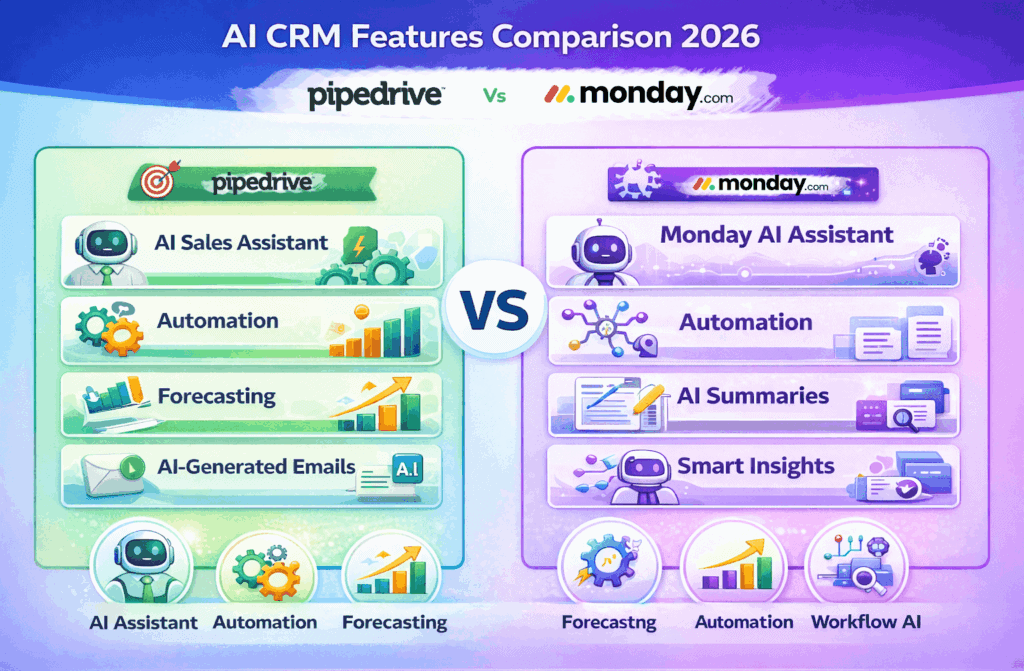
Here’s what stands out:
Pipedrive vs Monday: Ease of use
Ease of use is still one of the biggest predictors of CRM success.
The faster your team becomes comfortable with the platform, the faster you see pipeline movement and ROI.
In 2026, both tools have improved their onboarding and UI experiences — but they still feel very different in practice.
Pipedrive
Pipedrive was originally built to fix a common frustration: legacy CRMs were designed for reporting to executives rather than helping sales reps close deals.
That sales-first philosophy is still very visible in the product today.
The interface remains highly focused on pipeline flow, with most core actions — deals, contacts, activities, and automations — accessible within one or two clicks.
For sales teams, this dramatically reduces friction during daily use.
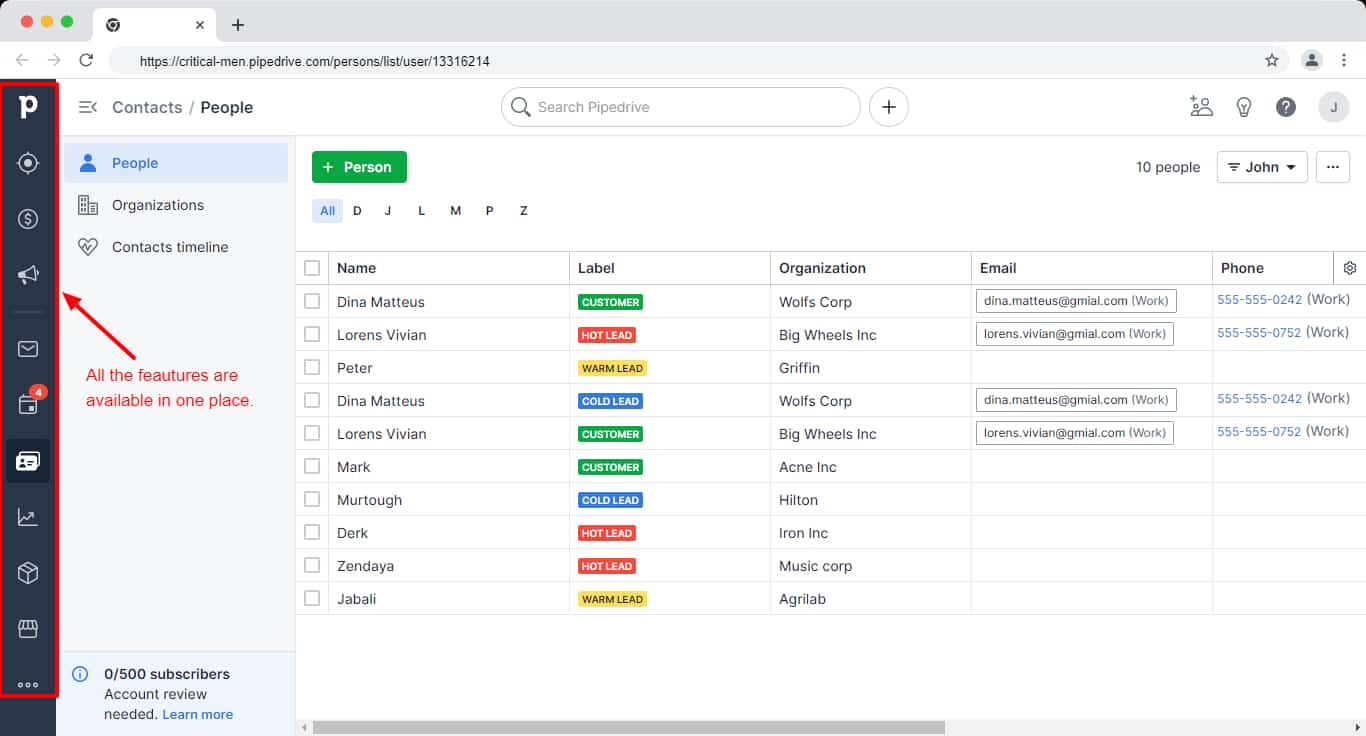
Key usability strengths in 2026:
-
-
-
Clean, visual pipeline layout
-
Minimal configuration required to start
-
Fast navigation between deals and contacts
-
Guided selling workflows
-
Short learning curve for new reps
-
-
Because of this opinionated design, many teams report faster adoption compared to more flexible CRM platforms.
As Eric J, head of sales, reviewed on G2:
“Adoption is a huge problem Pipedrive solves because it’s so easy to use and there’s no reason not to use it.”
AI assistance (2026 update)
Pipedrive has strengthened its AI Sales Assistant, which now helps teams:
-
-
-
Identify high-probability deals
-
Recommend next best actions
-
Highlight pipeline risks
-
Improve activity prioritization
-
Support smarter forecasting
-
-
This AI layer further reduces the cognitive load on reps — a meaningful usability advantage for sales-driven teams.
Additionally, Pipedrive continues to offer:
-
-
-
A dedicated learning academy
-
In-app chat support
-
Quick-start onboarding flows
-
-
👉 Bottom line: Pipedrive remains one of the easiest CRMs for sales teams to implement and adopt quickly.
Monday CRM
Monday CRM takes a different path. Instead of enforcing a predefined sales workflow, it provides a highly customizable no-code Work OS that teams can shape to their needs.
This flexibility is powerful — but it changes the usability equation.
Teams can:
-
-
-
Build a CRM pipeline from scratch
-
Use prebuilt templates
-
Configure custom automations
-
Add AI workflow blocks
-
Adapt boards for different departments
-
-
The platform’s visual design — especially its color-coded boards — remains a major usability highlight.
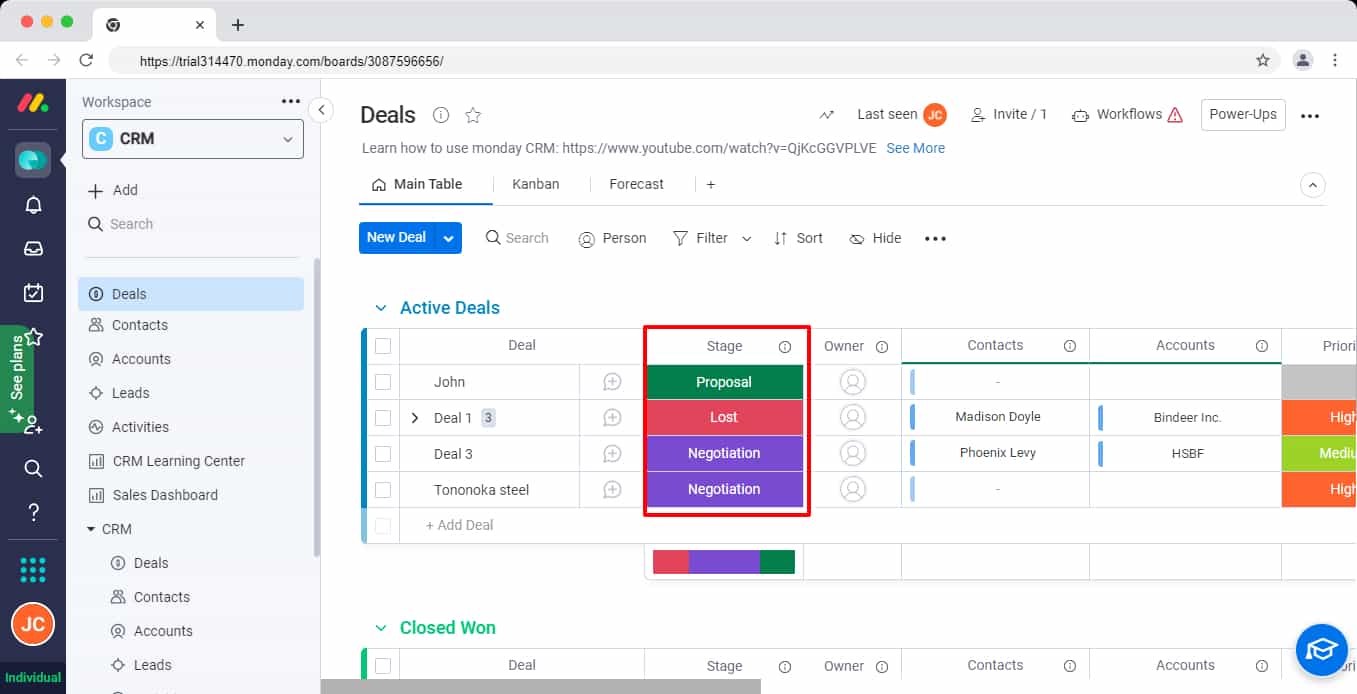
Users often praise:
-
-
-
Visual clarity through color coding
-
Flexible board structures
-
Drag-and-drop workflow setup
-
Cross-team visibility
-
Template-driven setup options
-
-
As Jade G, an intake coordinator, reviewed on G2:
“I think the best part of Monday is the fact that everything is so easy. It is so user-friendly and there are so many features that make the platform so easy to utilize. I really enjoy how you can download the boards, and colour code and make everything simple and effective.”
The 2026 reality check
Here’s the honest trade-off:
-
-
-
Monday CRM is very user-friendly after setup
-
But initial configuration usually takes longer than Pipedrive
-
Teams must decide their structure before getting full value
-
Highly customized setups can introduce complexity
-
-
👉 For teams that want a plug-and-play sales CRM, Monday can feel slightly busy at first.
👉 For teams that value flexibility, the extra setup is often worth it.
Read also: Pipedrive Vs Close Comparison: Which CRM Is Right For You?
Pipedrive vs Monday: Pricing (2026)
Pricing can make or break your CRM decision — especially in 2026, when most platforms bundle AI, automation, and reporting into tiered plans.
When comparing Pipedrive vs Monday CRM pricing, don’t just look at the lowest number. Evaluate:
-
-
-
Cost per user
-
Feature depth at each tier
-
AI and automation availability
-
Scalability as your team grows
-
-
Let’s break down the real numbers.
How much does Pipedrive cost in 2026?
Pipedrive now offers four streamlined pricing tiers designed primarily for sales teams.
Pipedrive pricing (annual billing):
-
-
-
Lite — ~$14/user/month
Core pipeline and lead management with basic reporting. -
Growth — ~$24/user/month
Adds email sync, workflow automation, and enhanced deal management. -
Premium — ~$49/user/month
Includes advanced reporting, forecasting, document management, and deeper automation. -
Ultimate — ~$69/user/month
Adds enhanced security, advanced permissions, and premium support.
-
-
What this means in practice:
Pipedrive’s pricing scales predictably with sales sophistication.
Most growing sales teams typically land in the Growth or Premium tiers, where the platform’s automation and AI features start delivering real value.
👉 Strength: strong sales functionality per user
👉 Watch-out: no permanent free plan
How much does Monday cost in 2026?
Monday’s pricing uses a seat-based pricing model built on its Work OS foundation.
Entry pricing is lower, but feature depth varies by tier.
Monday CRM pricing (annual billing):
-
-
-
Free — $0 (up to 2 seats)
Basic CRM capabilities for very small teams. -
Standard — $12/seat/month
Core CRM features, pipeline tracking, and basic automations. -
Pro — $19/seat/month
Advanced automations, reporting, and expanded customization.
-
-
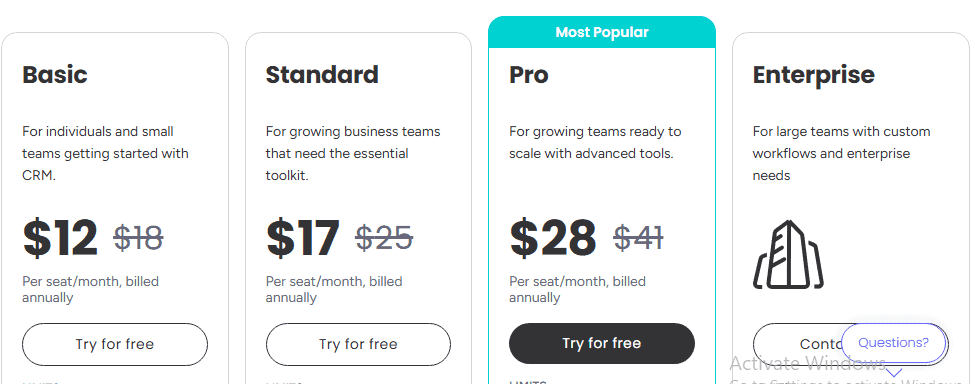
Monday CRM pricing
Important 2026 considerations
Monday’s pricing looks attractive at entry level, but real-world costs depend heavily on:
-
-
-
number of seats
-
automation needs
-
dashboard complexity
-
cross-team usage
-
-
Because Monday is highly customizable, teams often move up tiers as workflows mature.
Here’s what Tim L, a software consultant had to say about their pricing:
“It is more expensive than other similar platforms, and their pricing tiers tend to force users and businesses to the higher priced tiers. Even though they charge ‘per user’, they jump from 5 users to 10 users. Which makes a small business with 6 users pay double the price as if they had 5 users.”
👉 Strength: free plan and lower starting price
👉 Watch-out: costs can rise as customization and team size grow
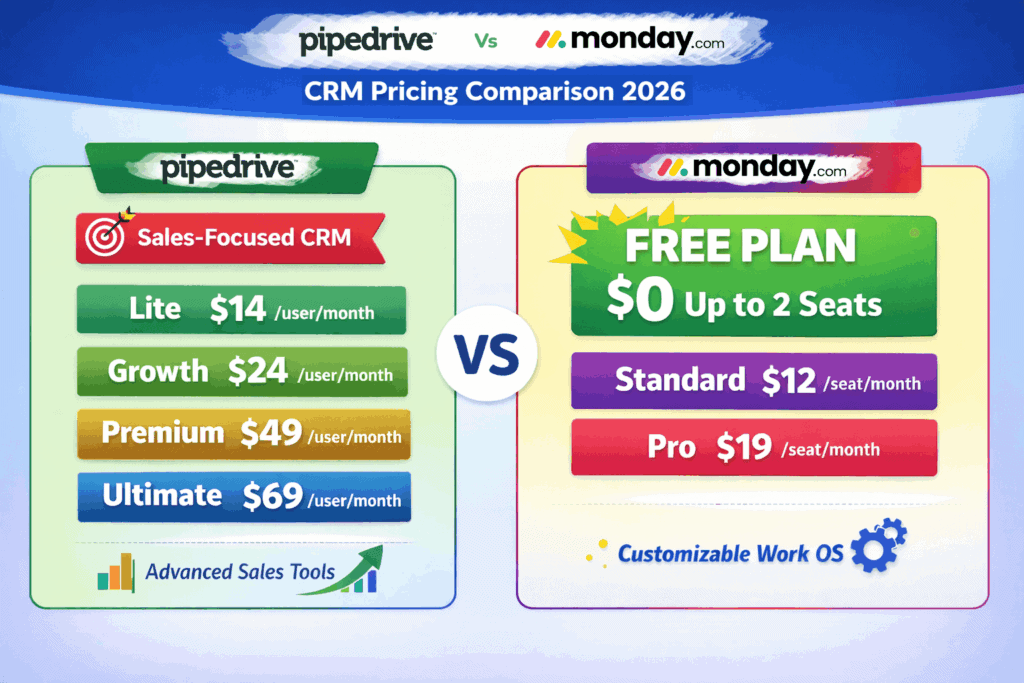
Pricing Verdict: Which CRM Is More Cost-Effective?
The answer depends on your use case in 2026.
Pipedrive is usually better value if:
-
-
-
You run a sales-heavy team
-
You want strong pipeline features out of the box
-
You value AI sales insights
-
You prefer predictable per-user pricing
-
-
Monday CRM is usually more affordable if:
-
-
-
You’re a very small team (2 users or fewer)
-
You need flexible workflows beyond sales
-
You want a free starting point
-
You’re comfortable configuring your own CRM structure
-
-
Bottom line
-
-
-
For pure sales ROI: Pipedrive often delivers stronger value per sales rep.
-
For budget-conscious or cross-functional teams: Monday CRM can be cheaper initially, especially with its free plan.
-
-
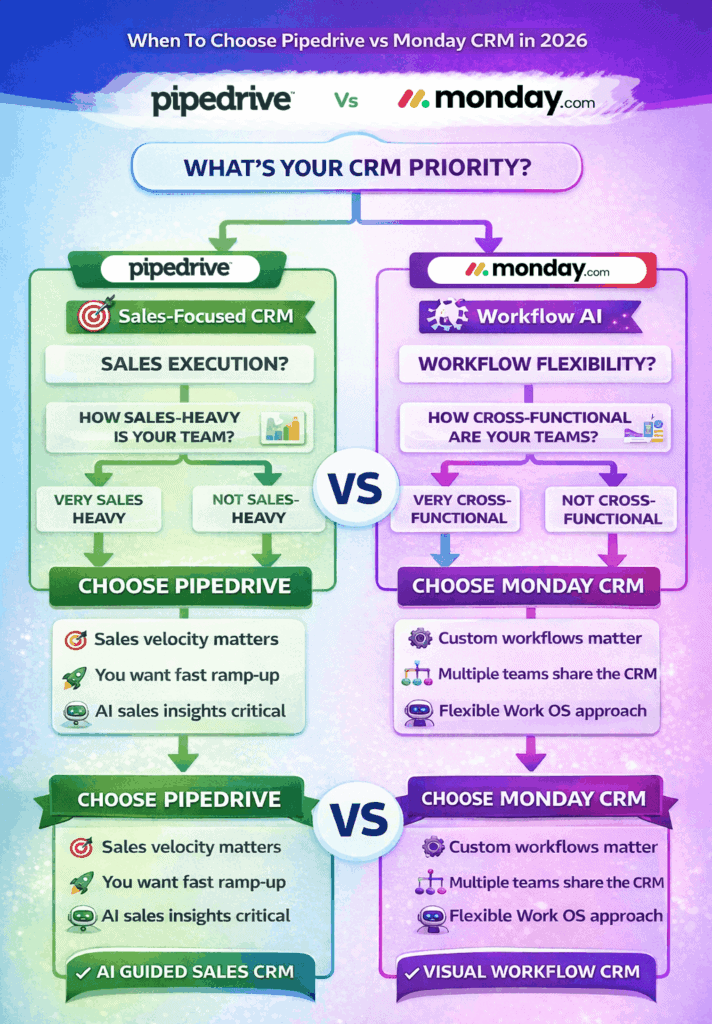
Choose based on total cost of ownership at scale, not just the entry price.
Read also: Pipedrive vs HubSpot vs EngageBay: Which CRM Is Smarter & Better?
EngageBay: A More Affordable & Powerful Alternative (2026)
If Pipedrive vs Monday CRM still feels like a trade-off between sales depth and customization, there’s a third option worth serious consideration in 2026: EngageBay.
EngageBay positions itself as an all-in-one CRM for sales, marketing, and support teams, built specifically for growing SMBs that want automation without enterprise-level pricing.
Instead of stitching together multiple tools, it brings core revenue workflows into a single platform.
For businesses focused on cost efficiency and unified customer data, this bundled approach can deliver faster ROI than using separate CRM, marketing, and helpdesk tools.
Why EngageBay stands out in 2026
Modern CRM buyers increasingly want:
-
-
-
Built-in marketing automation
-
Native lead generation tools
-
Helpdesk and customer support
-
Unified customer journey tracking
-
Affordable scaling
-
-
This is where EngageBay often differentiates itself from both Pipedrive and Monday CRM.
Free plan value comparison
EngageBay’s free forever plan includes many capabilities that typically require paid tiers in other platforms.
Compared with 2026 pricing:
-
-
-
Pipedrive entry starts at ~$14/user/month (Lite)
-
Monday CRM’s meaningful automation typically begins at paid tiers beyond Free
-
EngageBay includes multiple growth features at $0 for small teams
-
-
For early-stage businesses and lean teams, this can significantly lower total cost of ownership.
Lead generation: A key differentiator
Lead capture and nurturing remain major gaps in many CRM stacks.
In 2026:
-
-
-
Pipedrive offers strong sales tools but still relies on paid add-ons (like LeadBooster) for advanced lead capture.
-
Monday CRM focuses more on workflow flexibility and typically depends on integrations for full-funnel lead generation.
-
EngageBay includes native lead generation tools inside the platform.
-
-
With EngageBay, even free users can access:
-
-
-
Web pop-ups
-
Embedded forms
-
Live chat
-
Social media tools
-
Basic email marketing
-
-
This makes it particularly attractive for inbound-driven SMBs and digital-first teams.
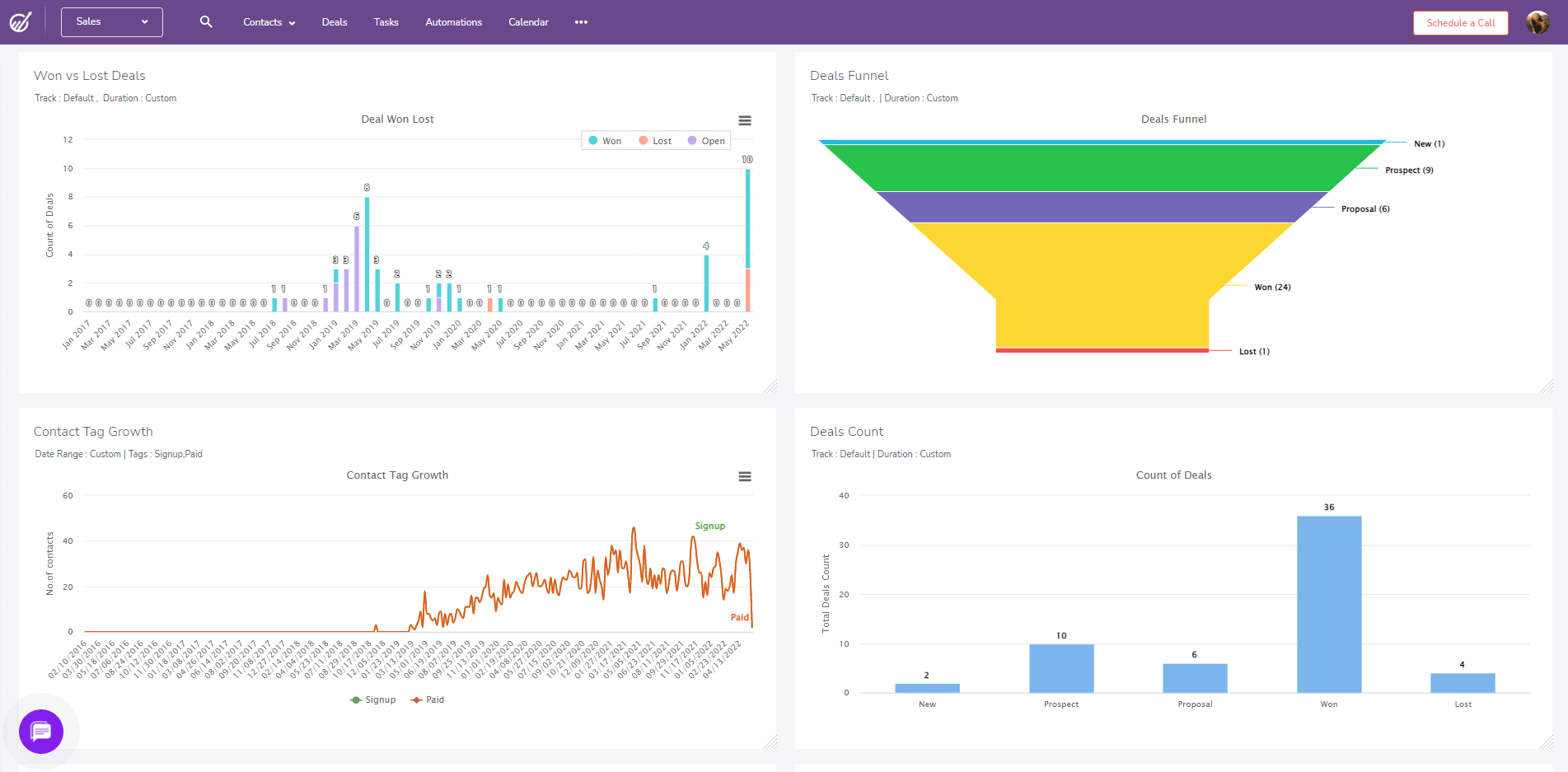
Unified customer journey tracking
Another area where EngageBay competes aggressively is end-to-end customer visibility.
The platform tracks touchpoints across:
-
-
-
email interactions
-
marketing campaigns
-
website behavior
-
support tickets
-
sales activities
-
-
This unified timeline helps teams:
-
-
-
personalize follow-ups
-
improve lead nurturing
-
align sales and support
-
reduce tool switching
-
-
For SMBs that don’t want fragmented data across multiple systems, this is a meaningful advantage.
Real user feedback
Lauraine M. highlights what many small businesses report about EngageBay — strong value for money combined with solid core functionality.
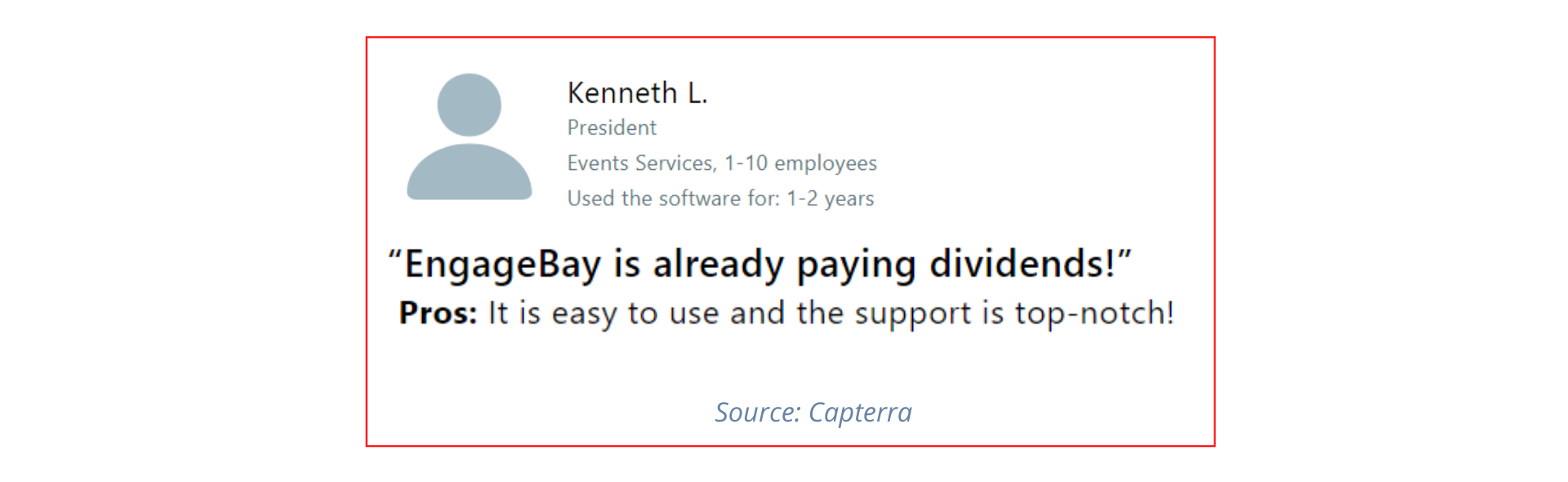
Thousands of users consistently cite:
-
-
-
Ease of use
-
Affordable pricing
-
Built-in lead generation
-
All-in-one convenience
-
Quick time to value
-
-
Bottom line
-
-
-
Choose Pipedrive if you want a pure, sales-first CRM with strong pipeline focus.
-
Choose Monday CRM if you need deep customization and cross-team workflows.
-
Choose EngageBay if you want an affordable all-in-one CRM with built-in marketing, sales, and support.
-
-
For growing SMBs that want maximum capability without stacking multiple subscriptions,
EngageBay often delivers the strongest value per dollar in 2026.
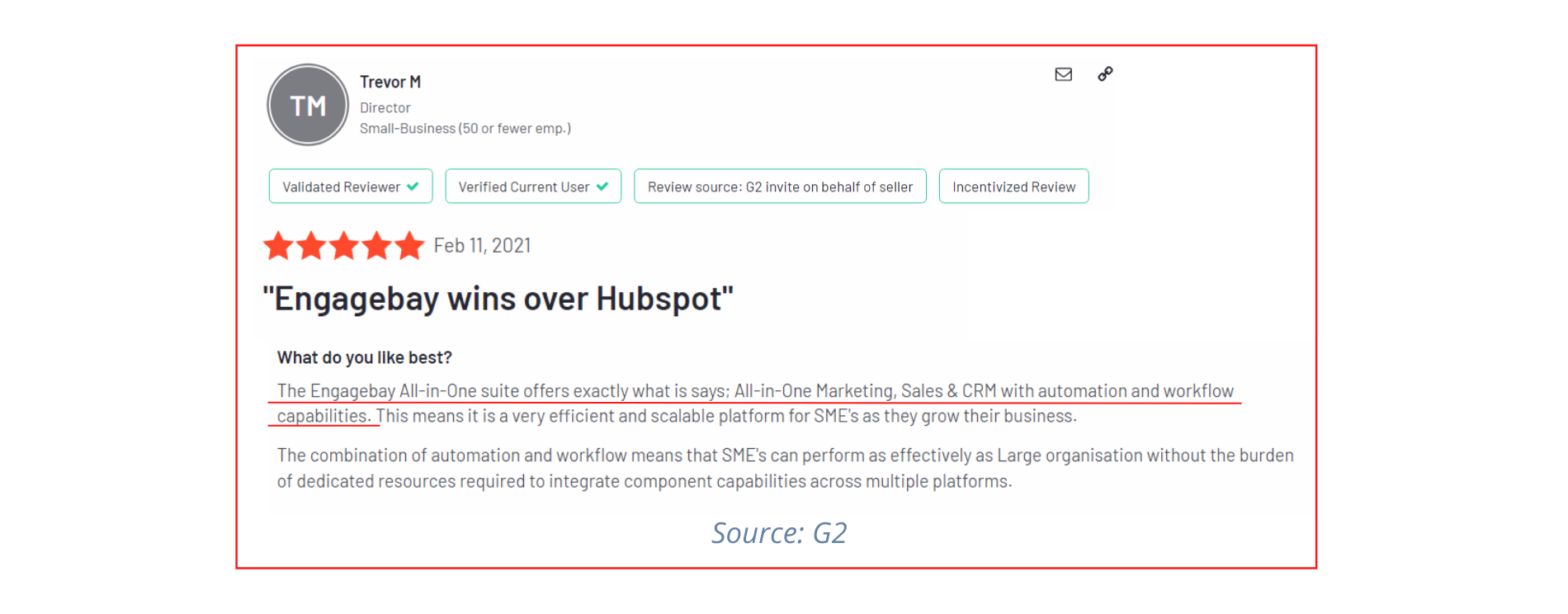
Lauraine M loves EngageBay — here’s a sweet testimonial about her experience with the affordable platform:
Wrapping Up: Pipedrive vs Monday CRM (2026)
In the Pipedrive vs Monday CRM debate, the right choice ultimately comes down to your team’s operating style and growth priorities in 2026.
Pipedrive remains a sales-first CRM built to help revenue teams move deals faster.
With its visual pipelines, AI Sales Assistant, and strong forecasting capabilities, it continues to excel for organizations that want structured, high-velocity pipeline management without heavy setup.
Monday CRM, by contrast, has evolved into a highly flexible Work OS–powered CRM.
Its no-code architecture, visual boards, and cross-team automation make it ideal for businesses that value deep customization and workflow orchestration beyond just sales.
But if you’re looking for a platform that balances affordability, built-in marketing, and unified customer journey tracking, EngageBay stands out as a compelling 2026 alternative.
For growing SMBs in particular, EngageBay delivers:
-
-
-
All-in-one sales, marketing, and support
-
Native lead generation tools
-
Automation across the customer lifecycle
-
Lower total cost of ownership as you scale
-
-
Bottom line:
-
-
-
Choose Pipedrive for focused, AI-driven sales execution.
-
Choose Monday CRM for flexible, cross-functional workflow management.
-
Choose EngageBay if you want the broadest capability set at the most cost-efficient price point as your business grows.
-
-
Pipedrive is typically better for dedicated sales teams due to its pipeline-first design, AI deal insights, and forecasting tools. Monday CRM is stronger for cross-functional workflow management and customization.
Yes. Monday CRM includes AI blocks for content generation, summaries, and workflow automation. However, its AI is broader workflow-focused rather than deeply sales-specific like Pipedrive’s AI assistant.
Monday offers a free plan for up to two users, making it cheaper for very small teams. Pipedrive starts around $14/user/month but delivers stronger sales-focused functionality.
Yes. Monday CRM works well for small businesses needing flexible workflows and collaboration. However, sales-heavy teams may find Pipedrive’s pipeline tools more specialized and efficient.
Pipedrive is a sales-focused CRM built around pipeline management, while Monday CRM is a highly customizable work OS platform that includes CRM capabilities for broader team workflows.
