

Here is an uncomfortable number: 8.
That is how many times more likely you are to convert a lead if you respond within five minutes of their inquiry, compared to waiting even half an hour.
The research behind this comes from a landmark study published in Harvard Business Review — “The Short Life of Online Sales Leads” which analyzed over 1.25 million leads across 2,241 companies.
The finding has been reproduced so many times in the years since that it is now considered the closest thing sales has to a law of physics.
Now here is the companion number that makes the first one almost funny: 47 hours.
That is the average lead response time for B2B companies; nearly two full business days, according to InsideSales.com‘s 2025 research tracking 5.7 million inbound leads across 400+ companies.
So, you have a stat proving that five minutes is worth 8x more conversions, and you have an industry averaging 47 hours. That gap is not a nuance. It is a revenue leak most SMBs do not even know they have.
This article is about that gap, why it exists, who pays for it, and what a sales team of any size can actually do to close it. No enterprise budget required.
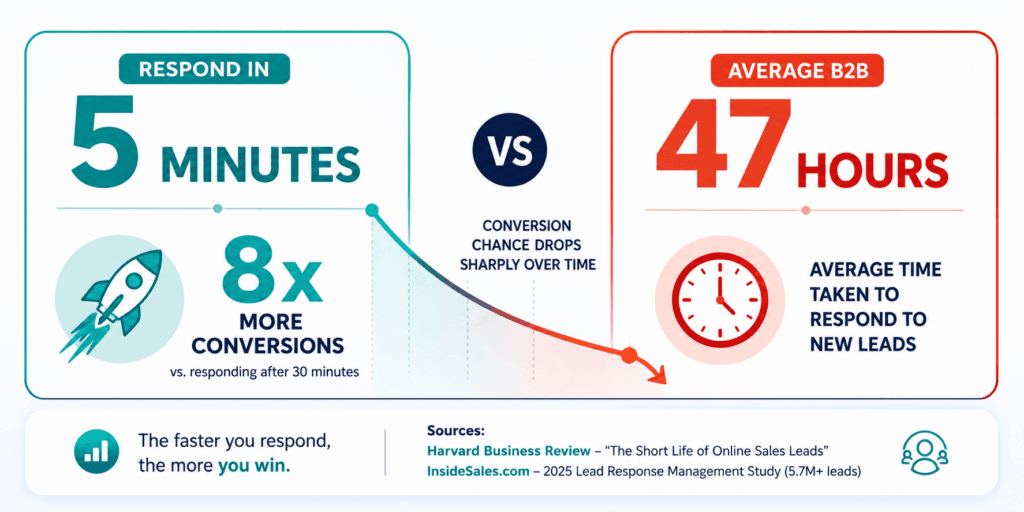
Table of Contents
The Science Behind Lead Response Time (Why 5 Minutes Changes Everything)
Think about what a prospect is actually doing in the moment they fill out your contact form or click “Request a Demo.”
They are not doing one thing. They almost certainly have three or four other vendor tabs open in their browser.
They are comparing pricing pages, skimming reviews on G2 or Capterra, and mentally ranking who feels most responsive.
Their intent is at its highest point of the entire sales cycle: right now, at this second. That window does not stay open long.
The HBR study, authored by David Elkington and James Oldroyd and published in 2011, tracked 15,000 unique leads and over 100,000 call attempts.
Their headline finding: firms that contacted leads within an hour were nearly seven times more likely to qualify the lead than those that waited even 60 minutes.
Waiting 24 hours or more? The qualification odds collapsed by 60 times compared to a sub-hour response.
The MIT Lead Response Management Study — conducted by Dr. James Oldroyd in partnership with InsideSales.com went further.
Across millions of sales interactions, it found that the probability of successfully making contact with a lead is 100 times greater in the first five minutes versus the 30-minute mark.
Not 10% better. Not twice as good. One hundred times.
What happens at the neurological level is not mysterious. A prospect submitting a form is in a state of active consideration, their working memory is full of the problem they are trying to solve.
The moment they hit submit, that mental focus begins to dissipate. They get a Slack message. A meeting reminder fires. Their phone rings. By the time your sales rep manually pulls up the CRM, checks the lead, finds the contact details, and fires off a reply; that prospect has mentally moved on, even if they have not explicitly chosen a competitor yet.
And they often have chosen a competitor. A Drift lead response study found that 78% of customers buy from the first company to respond to their inquiry.
Not the cheapest. Not the one with the best product. The fastest. That is the operating reality of modern B2B buying behavior.
“The average business takes 47 hours to follow up on a lead. The average buyer has mentally moved on in 47 minutes. That gap is not a sales problem — it is a systems problem, and it is entirely solvable.”
— Radhika Mohan Singh Roy, Head of Marketing, EngageBay
The concept of “lead temperature” is useful here. A lead is warmest the moment they raise their hand.
Every minute that passes without a response lets that temperature drop. By the time you call 24 hours later, you are not re-engaging a warm prospect, you are cold-calling someone who already has a vague memory of having once been interested in you.
Lead Response Time Benchmarks by Industry (How Does Your Business Stack Up?)
The 47-hour average is a useful headline number, but it masks meaningful variation across sectors.
Real estate companies are considerably faster than manufacturing firms. SaaS companies, despite being technology businesses, are often surprisingly slow.
Here is what the data actually looks like when you break it down.
| Industry | Average Response Time | % of Leads Never Responded To | Recommended Target |
|---|---|---|---|
| SaaS / Technology | 11–12 hours | ~35% | < 5 minutes |
| Professional Services | 24–36 hours | ~40% | < 30 minutes |
| Healthcare | 8–14 hours | ~28% | < 15 minutes |
| Real Estate | 5–6 hours | ~30% | < 5 minutes |
| Financial Services | 8–10 hours | ~32% | < 10 minutes |
| E-commerce / Retail | 2–4 hours | ~20% | < 5 minutes |
| General B2B | 42–47 hours | ~38% | < 1 hour |
Sources: GreetNow Lead Response Time Statistics (2025–2026), compiled from Salesforce State of Sales, Drift Lead Response Report, InsideSales.com, and industry-specific research from NAR and Hatch.
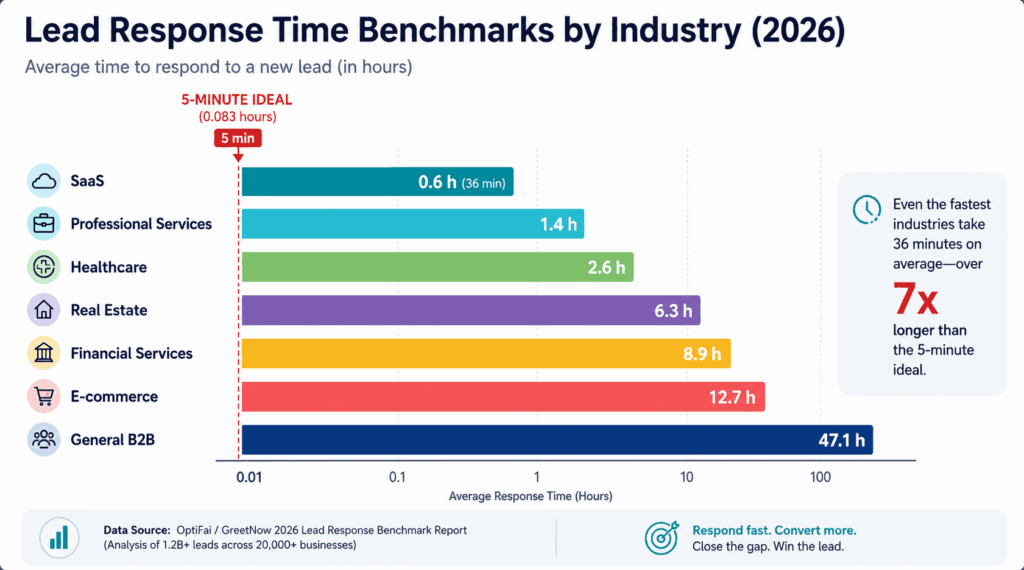
A few things worth noting from this table. First, even the “fast” industries are not actually fast by the five-minute standard. Real estate averaging five hours is better than B2B averaging 47, but it is still nowhere near the threshold where conversion rates peak.
Second, the “% of leads never responded to” column is where the real money is being left on the table, in some industries, over a third of all paid inbound leads simply receive no reply at all.
The B2B-versus-B2C gap is partly structural. B2B sales cycles typically involve more stakeholders, longer qualification processes, and a cultural norm of “we will follow up in a day or two” that has calcified into standard practice.
B2C buyers, particularly for high-ticket purchases, often behave more like B2B buyers than people assume; they are comparing options, and the first response still wins a disproportionate share of deals.
For SaaS businesses specifically, the stakes are higher than the 11-to-12-hour average suggests. Someone who signs up for a free trial or requests a demo is at peak intent. They are in the evaluation phase of a product-led funnel.
If no one from your team engages them within a few hours, they will evaluate your product alone, and without context, most self-serve evaluations fail. The trial expires. The account goes cold. The prospect churns before ever becoming a customer.
There is also the after-hours problem, and it is bigger than most teams acknowledge. Research compiled by GreetNow from Salesforce and Drift data suggests that 52% of B2B leads come in outside standard business hours.
That means more than half of your inbound demand lands when no one is watching the inbox.
Without automation, those leads wait until morning, by which point the five-minute window is not missed by hours. It is missed by an entire night.
New 2026 SMB Lead Response Benchmarks
Most lead-response studies cited online originate from a small number of landmark reports published over the last decade.
While those studies remain valuable, the reality of modern lead management has evolved dramatically. Today’s buyers expect immediate acknowledgment, self-service scheduling, and near real-time communication across multiple channels.
To help small and mid-sized businesses benchmark their own performance, EngageBay has launched the 2026 SMB Lead Response Benchmark Initiative, which combines industry research from Salesforce, Drift, MIT, Harvard Business Review, InsideSales.com, and other leading sources into a single reference framework.
Download the Full Benchmark Report
The report includes:
- Industry-specific response-time benchmarks
- Lead abandonment statistics
- After-hours lead trends
- Revenue impact calculations
- Recommended SLA targets by industry
- CRM adoption trends among SMBs
Download: The 2026 SMB Lead Response Benchmark Report (PDF)
The Hidden Cost of Slow Lead Response
Most companies assume they have a lead-generation problem.
In reality, many have a lead-management problem.
Research from multiple industry studies suggests that between 20% and 40% of inbound leads receive no response at all. Combined with average response times that often exceed several hours—or even days—this creates one of the largest hidden revenue leaks inside modern sales organizations.
The challenge is especially severe for SMBs.
Unlike enterprise companies with dedicated sales development teams, small businesses often rely on founders, account managers, or general sales representatives to manage inbound inquiries while simultaneously handling customer service, delivery, and operations.
The result is predictable:
- Leads arrive after business hours.
- No one owns follow-up.
- Requests sit in shared inboxes.
- Prospects move to competitors.
The issue is rarely effort.
It is usually infrastructure.
5 Reasons SMBs Struggle to Respond Fast (And Why It’s Not Laziness)
I want to be direct about something before we get into the reasons: most small business sales teams are not slow because they do not care.
They are slow because their systems are not built for speed. The five-minute window is a process problem, not a motivation problem.
Here is what that looks like in practice.
1. Leads Land in the Wrong Inbox
A typical SMB collects leads from five or six different places: a website contact form, a live chat widget, a Facebook lead ad, a LinkedIn message, a phone call, and the generic ‘info@’ email address that three people sort-of-monitor.
Each of these channels routes to a different person, or more accurately, to no person in particular.
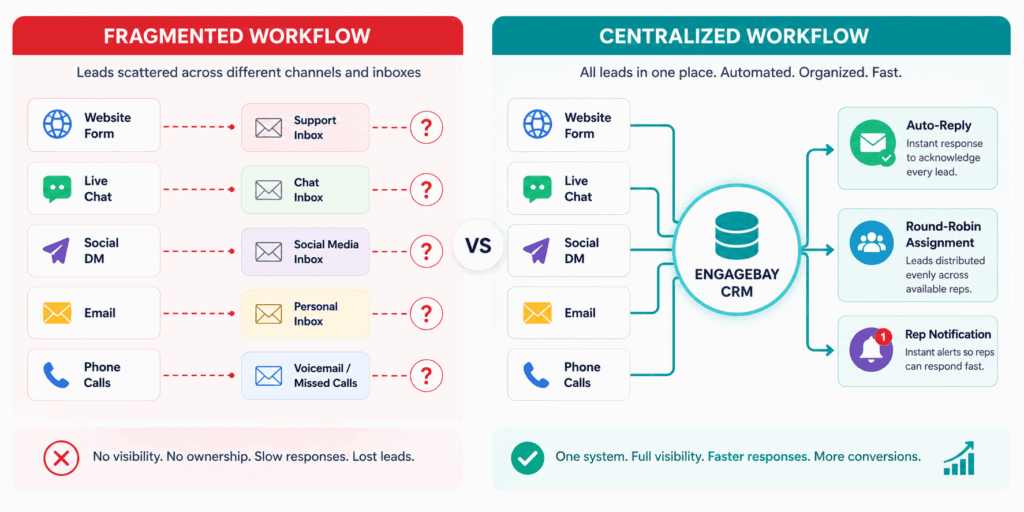
The result is what you might call the fragmented inbox problem.
A hot lead fills out a demo request form at 2:47pm on a Tuesday. The form submission arrives in a shared Gmail inbox. The one person who usually handles that inbox is on a client call. The lead waits. The call ends at 3:30pm. The rep opens the inbox, sees seventeen emails, and works through them in rough chronological order. The demo request gets a reply at 4:15pm. Ninety minutes have passed. The prospect is already on a competitor’s call.
Centralizing all lead sources into a single CRM, where every submission, regardless of channel, lands in one place and triggers a notification, is the structural fix. Without it, you are patching a plumbing problem with paper towel.
2. There’s No Automated First Response
The first response does not need to be a full sales conversation. It needs to do two things: confirm receipt and buy time for a human to follow up.
An automated acknowledgment email: “Thanks for reaching out, [Name]. A member of our team will be in touch within the hour”, accomplishes both. The lead feels seen. The clock starts on your end. The pressure to respond immediately is partially absorbed.
Most SMBs do not have this in place. Their first response is a manual email from a rep, sent whenever that rep happens to be available.
The difference between an automated acknowledgment and no response might only be a few words, but it is the difference between a lead who feels engaged and a lead who is already second-guessing their choice to reach out.
In practice, the automated first response should fire within 60 seconds of a form submission. It should include the rep’s name who will follow up, a rough timeframe, and ideally a link to book a call directly; so a particularly motivated lead can self-schedule without waiting for a human to propose times.
3. No Lead Routing Rules
Even when a lead lands in the right place, a common question follows: who owns it?
In a team of three or five sales reps, the answer is often “whoever sees it first” or “whoever I assign it to manually.” Neither of these is a system. Both are bottlenecks.
Round-robin lead assignment solves this cleanly. The CRM automatically distributes incoming leads in sequence: rep one gets lead one, rep two gets lead two, rep three gets lead three, rep one gets lead four; so no one gets overloaded and no lead sits in a queue waiting for a human assignment decision.
Reps get an immediate notification on whatever device they are using. The first response clock starts before the lead even knows they have been assigned.
For teams with geographic or product-line specializations, routing rules can go further: assigning leads based on the form they completed, the page they submitted from, or the region they selected.
The point is that the routing decision happens automatically, not manually, and it happens in seconds rather than minutes.
4. CRM Gaps or No CRM at All
This one is more common than most sales consultants want to admit.
According to research compiled from Capterra and Fitsmallbusiness.com data:
Roughly 40% of small businesses still manage leads in spreadsheets, shared inboxes, or paper-based systems.
No CRM means no automated alerts, no lead status tracking, no visibility into which leads have been contacted and which have not, and no ability to trigger workflows when a new lead arrives.
Without a CRM, lead response time is entirely dependent on one person’s availability and memory.
That is not a scalable system for a business with 10 leads a month. For a business with 100, it is a guaranteed revenue leak.
The good news is that the barrier to entry for CRM has dropped dramatically. Decent all-in-one CRM tools, including EngageBay’s free plan., are available to businesses of any size.
The argument that CRM is “for bigger companies” stopped being accurate about a decade ago.
5. No SLA for Lead Response
Enterprise sales teams have formal Service Level Agreements for lead response: a defined maximum response time, a consequence for missing it, and a reporting mechanism to track performance.
Most SMBs have none of this: no standard, no accountability, no measurement.
When there is no defined expectation, response time defaults to “whenever.”
When there is a defined expectation: “we respond to all inbound demo requests within five minutes during business hours, and within one hour outside business hours”, behavior changes.
Not because reps are suddenly more motivated, but because there is now a number to hit and a way to know whether you hit it.
Setting a response-time SLA does not require a legal document or an HR policy. It requires a decision, a conversation with your team, and a CRM that tracks and reports the metric.
That’s it.
What High-Performing Teams Do Differently
The fastest-growing companies do not necessarily have the largest sales teams.
What they have is a repeatable system.
Across industries, high-performing sales organizations tend to share four characteristics:
They Respond Automatically
Every inquiry receives immediate acknowledgment, regardless of time of day.
They Assign Ownership Immediately
Every lead has a clearly defined owner within seconds of submission.
They Track Response Time
Lead response time is measured and reviewed just like revenue, conversion rate, and pipeline value.
They Escalate Delays
When response targets are missed, backup workflows automatically trigger.
This is why lead response time should be viewed as an operational KPI rather than merely a sales metric.
The organizations that consistently outperform their competitors are usually not working harder.
They are simply removing delay from the system.
How to Fix Your Lead Response Time: A Practical Playbook
None of what follows requires a large team or an enterprise software budget. These are operational changes that a business of five people can implement in a week, with the right tool in place.
Set a Response Time SLA (Even if You’re a Team of 3)
Start by defining what “acceptable” looks like. For hot inbound leads, anyone who requests a demo, fills out a pricing inquiry form, or initiates a live chat, the target should be five minutes or less.
That sounds aggressive until you realize that with an automated workflow, your CRM can hit that window without any human doing anything except picking up their phone to make the follow-up call.
For general inquiries; contact form submissions that are lower intent, newsletter sign-ups that have not clicked a pricing page, a one-hour maximum is a reasonable and achievable standard for most SMBs.
Write this down. Share it with your team. Put it in your CRM as a tracked metric. The moment you start measuring something, you start improving it.
That is not a motivational phrase, it is how performance management actually works.
Build an Automated First-Response Workflow
Here is the basic workflow that every inbound-focused SMB should have running before they do anything else:
Step 1. Prospect submits a web form (contact, demo request, pricing inquiry).
Step 2. CRM receives the submission and immediately sends an automated acknowledgment email, personalized with the prospect’s name and the rep who will follow up.
Step 3. CRM fires a notification to the assigned rep via email and/or mobile app: “New lead: [Name] from [Company] just requested a demo.”
Step 4. If the rep has not logged a response within 15 minutes, the CRM sends a secondary escalation alert to the rep’s manager or to a backup rep.
Step 5. If there is still no human response within one hour, the lead automatically enters a nurture email sequence so they keep receiving value from you while a human catches up.
That workflow means no lead ever disappears into silence. The automated acknowledgment covers the first-response window.
The escalation alert prevents the lead from getting lost in a rep’s inbox.
The nurture sequence ensures you are still in the conversation even if the human follow-up is delayed.
Use Round-Robin Lead Assignment
The simplest way to explain round-robin assignment: imagine three reps: Sarah, Marcus, and Priya.
When the first lead comes in, the CRM assigns it to Sarah. The second goes to Marcus. The third to Priya. The fourth goes back to Sarah. The cycle repeats, and every lead has an owner within seconds of arriving.
This eliminates the “who handles this?” conversation entirely.
Reps get notified immediately upon assignment. Managers can see in real time which leads are unworked.
Response time tracking becomes meaningful because ownership is clear from the moment a lead enters the system.
For teams with geographic territories or product specializations, routing rules can layer on top of round-robin: “all enterprise leads go to Marcus, all startup leads rotate between Sarah and Priya”, without complicating the fundamental speed advantage.
👉 Download the CRM Lead Routing Guide
Use CRM Lead Response Automation: Where EngageBay Comes In
There are several CRM tools on the market that handle lead response automation well.
HubSpot does it thoroughly, though at a price point that most SMBs find difficult to justify, especially once the contact limits kick in.
Salesforce is comprehensive but comes with significant setup complexity and cost. Pipedrive handles pipeline management cleanly but requires additional tools for marketing automation.
EngageBay’s sales CRM is worth attention specifically because it bundles the pieces that most SMBs need to solve the lead response problem: auto-responder triggers, round-robin assignment, lead source tracking, and response time reporting; into a single platform, starting at $12.74 per user per month.
For a three-person sales team, that is less than the cost of a single enterprise seat on most competing platforms.
In practice, EngageBay’s automation builder lets you create the exact workflow described above: form submission triggers an instant acknowledgment, rep gets a push notification, escalation fires at 15 minutes, nurture sequence kicks in at one hour; without writing a line of code.
The round-robin assignment is a native feature, not an add-on. Lead source tracking tells you which channels are generating leads, and which are generating leads that actually convert, so you can allocate marketing spend accordingly.
The response time reporting is particularly useful for teams trying to build accountability.
You can see, at the rep level, the average time between lead assignment and first contact.
When that number is visible to the whole team, it tends to improve on its own.
EngageBay is trusted by 135,000+ businesses worldwide, which is worth mentioning not as a vanity number but as evidence that this is not a hobbyist tool, it handles real lead volumes at real company scale.
If you are in the early stages of building your CRM strategy, or reassessing how you measure sales performance metrics, the lead response workflow is the single highest leverage change you can make.
Everything else: lead scoring, pipeline stages, forecasting; is built on top of the assumption that you are actually talking to your leads. Fix the response time first.
EngageBay’s marketing automation tools extend this further, allowing you to build multi-step nurture sequences that keep leads engaged across email, social, and other channels while your team focuses on the highest-intent follow-ups.
The Lead Response Gap: Why 47 Hours Is a Crisis
One statistic continues to appear across sales, CRM, and marketing research:
The average B2B company takes approximately 47 hours to respond to a lead inquiry.
Now compare that with another widely cited benchmark:
The probability of connecting with a lead is up to 100 times higher during the first five minutes after inquiry.
The difference between those two numbers represents one of the largest inefficiencies in modern revenue generation.
5 Minutes vs. 47 Hours
| Metric | Benchmark |
|---|---|
| Ideal response time | Under 5 minutes |
| Industry average | 47 hours |
| Gap | 564x longer than recommended |
This is not a marginal optimization opportunity.
It is a structural business problem.
Every hour that passes reduces the likelihood of making contact, qualifying the lead, and ultimately winning the business.
The Revenue Math: What Slow Response Time Is Actually Costing You
Let’s make this concrete.
Assume your business receives 100 inbound leads per month, a modest number for most companies that have any marketing activity at all.
Based on Drift’s research, roughly 58% of companies never respond to a lead inquiry at all.
Even if your team is better than average and you respond to 80% of your leads, the math on the ones you miss is brutal.
That is 20 leads per month; leads who filled out a form, expressed interest, and received silence.
Now apply the conversion rate data. Leads contacted within five minutes convert at 8 times the rate of leads contacted after 30 minutes, per InsideSales.com’s 2021 research across 55 million sales activities.
If your current average response time is two hours, your contact rate and qualification rate are both operating well below their potential.
Even modest improvements such as moving from two hours to 30 minutes meaningfully improve downstream conversion.
Here is a simple model. Average deal size: $500 per year (a reasonable SaaS or professional services SMB number). Current conversion rate from inbound leads: 5%.
With faster lead response, sub-five-minute auto-acknowledgment plus same-day human follow-up, the research suggests you could move that to 10% to 15% conversion on properly worked leads.
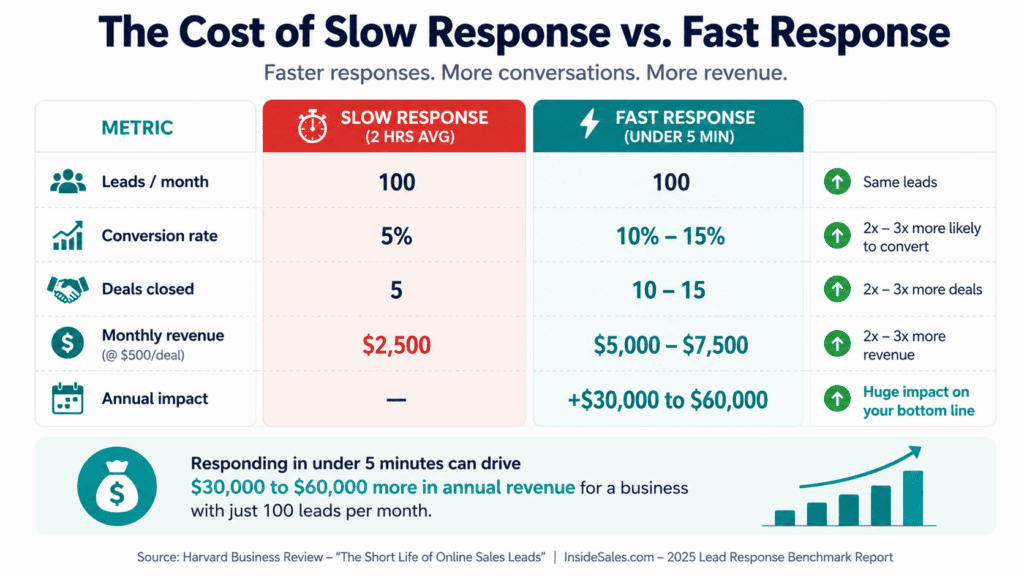
On 100 leads per month: that is the difference between 5 deals and 10 to 15 deals. At $500 per deal, that is $2,500 to $5,000 more in monthly recurring revenue.
Annually, you are looking at $30,000 to $60,000 in additional revenue; from the same lead volume, with the same team, by changing nothing except how fast you respond.
“Speed to lead is not a sales tactic. It is a revenue infrastructure decision. Every hour your average response time drops, your effective marketing budget gets a little more efficient — because you are actually closing the leads you already paid to generate.”
— Radhika Mohan Singh Roy, Head of Marketing, EngageBay
The stat from Salesforce’s research that should sharpen this further: only 27% of leads ever get contacted at all across the B2B landscape.
If your team is consistently reaching 80% or more of your inbound leads within a reasonable time window, you are already outperforming the majority of your market.
The question is whether “outperforming average” is enough, or whether you want to optimize toward the 5-minute benchmark where conversion rates are genuinely exceptional.
“For small business sales teams, lead response time is not a nice-to-have metric. It is the difference between a closed deal and a lost prospect who is already on a competitor’s demo call — probably with the first company that bothered to reply.”
— EngageBay Research Team
Find Out Exactly What Slow Response Is Costing Your Business
The numbers above are industry averages. Your actual revenue gap depends on your specific lead volume, deal size, and current response time — and those variables move the output significantly.
EngageBay’s free Lead Response Time Calculator runs the math for your business in under 60 seconds.
Enter your monthly lead volume, average deal value, and current response time, and it returns a clear figure: the revenue you are leaving on the table every month by not responding faster.
No signup required. No email needed. Just a number that is specific to your pipeline — and probably uncomfortable enough to make you act on it.
Additional Resources
If you are evaluating your lead management process, these resources may help:
Lead Response Time Calculator
Calculate the revenue impact of slow lead follow-up using your own lead volume and average deal size.
👉 Calculate Your Lead Response Revenue Gap — Free
2026 SMB Lead Response Benchmark Report
Compare your response time against industry averages.
👉 Download the Benchmark Report
CRM Lead Routing Guide
Learn how round-robin assignment and automation workflows reduce response delays.
👉 Download the CRM Lead Routing Guide
Lead Response SLA Template
Use a ready-made response-time policy for your sales team.
👉 Download the Lead Response SLA Template
Wrapping Up
The five-minute window is not going to get wider. As buyer expectations continue to shift, shaped by AI assistants, instant live chat, and the general acceleration of digital-first purchasing, the tolerance for slow follow-up will only shrink further.
Right now, responding within an hour puts you ahead of most of your market. In three years, that bar will likely be 15 minutes.
The businesses that win this race are not the ones with the biggest sales teams. They are the ones that build systems; simple, repeatable, automated systems, so that a lead who submits a form at midnight on a Friday gets an acknowledgment in 30 seconds and a human call at 9am Monday, not a reply on Tuesday afternoon.
If your team is still relying on manual follow-up, the gap between you and your best competitors is already costing you deals you do not even know you are losing.
EngageBay’s CRM lets you build automated lead response workflows, round-robin assignment, and response-time tracking in an afternoon.
No enterprise budget. No developer. Just a system that works while you are busy doing everything else.
👉 → Start your free EngageBay trial and respond to your next lead in under 5 minutes
Or book a live demo and we will walk you through the lead response setup personally.
Lead response time is the elapsed time between a prospect submitting an inquiry — through a web form, live chat, email, or phone call — and receiving the first meaningful contact from a sales representative or an automated CRM response. It is one of the most directly measurable predictors of conversion rate in inbound sales, and it is tracked as a core metric in any well-run CRM system.
The research consistently points to five minutes as the critical threshold. The MIT Lead Response Management Study, conducted by Dr. James Oldroyd in collaboration with InsideSales.com, found that contact rates are 100 times higher when a lead is reached within five minutes versus 30 minutes. For most SMBs, achieving a sub-five-minute response on every lead requires automation — a human-only process simply cannot be that consistent. That said, even moving from a 24-hour average to a sub-one-hour average produces meaningful conversion improvements and puts you well ahead of most competitors.
Directly and significantly. InsideSales.com’s 2021 research — covering 55 million sales activities across 5.7 million inbound leads — found that conversion rates drop by 8 times after the first five minutes. The Harvard Business Review’s analysis found that companies responding within one hour were seven times more likely to qualify a lead than those waiting longer. After 24 hours, the conversion data is essentially flat — the lead has cooled, moved on, or already chosen a competitor. Knowing how fast to respond to leads is therefore not a tactical preference; it is the most consequential operational decision in your inbound sales process.
CRM lead response automation is the use of CRM software to automatically acknowledge, assign, notify, and follow up with leads the moment they enter your system — without requiring a human to manually trigger any of those actions. A complete automated first-response workflow typically includes: an instant acknowledgment email to the lead, a push notification to the assigned rep, a round-robin assignment decision, an escalation alert if the rep does not respond within a defined window, and an entry into a nurture email sequence for non-responsive leads. The automation handles the first five minutes; the human handles the conversation that follows.
Four changes have the most direct impact for SMBs, in rough order of priority. First, set up automated acknowledgment emails so no lead ever receives silence, even at 2am. Second, centralize all lead sources — forms, chat, social, email — into a single CRM so there is no fragmentation of who sees what. Third, implement round-robin lead assignment so every lead has a named owner within seconds of arrival. Fourth, define an internal response-time SLA and measure it monthly. For lead nurturing for small businesses, the nurture sequence that kicks in after the initial outreach attempt is equally important — it keeps the conversation alive for leads that do not convert immediately.
EngageBay is the most affordable all-in-one option for SMBs — it includes CRM, marketing automation, automated workflows, round-robin assignment, and response time reporting starting at $12.74 per user per month, with a free plan available. HubSpot offers strong automation features on its paid tiers, though the pricing scales quickly and becomes costly for smaller teams. Pipedrive handles pipeline management and basic automation well, with a clean interface suited to small sales teams. ActiveCampaign is worth considering if email automation depth is the priority. For most SMBs trying to solve the lead response problem without a large budget, EngageBay’s combination of price and feature coverage is genuinely difficult to match.
