
Last updated: 6 October 2026
Freshdesk is still a well-known customer support platform, but it is not automatically the best fit for every support team.
The right choice depends on the size of your team, the channels you use, how much automation you need, whether you already have a CRM, and how you want to pay for AI.
This guide compares 16 Freshdesk alternatives. We look at pricing, core support features, AI, integrations, strengths, limitations, and the type of business each product suits best.
You will find broad helpdesk platforms such as Zendesk and Zoho Desk, email-first tools such as Help Scout and Hiver, ecommerce-focused support from Gorgias, IT-focused service management from Jira Service Management, and enterprise platforms such as Salesforce Service Cloud.
One important note: helpdesk pricing has become more complicated. Some products charge per agent or seat, some charge by ticket volume, and some add usage-based AI fees. A low starting price is therefore only a starting point. Before you choose a platform, calculate the cost for your actual team size and support volume.
All prices in this article are presented as of October 2026. Billing terms and regional prices can differ. Always confirm the final commercial quote with the vendor before purchasing.
Here’s a good list of Freshdesk alternatives:
- EngageBay
- Zendesk
- Zoho Desk
- Help Scout
- REVE Chat
- LiveAgent
- Front
- Intercom
- HubSpot Service Hub
- TeamSupport
- Kustomer
- Gorgias
- Tidio
- Jira
- Salesforce
- Hiver
Quick picks: Which Freshdesk alternative is best?
|
Need |
Best starting point |
Why it stands out |
|
Best for small businesses |
EngageBay |
Combines service, CRM, marketing and sales capabilities; current EngageBay prices require internal confirmation. |
|
Best free options |
Zoho Desk, Help Scout, Jira Service Management, HubSpot Service Hub |
Each has a current free tier or edition, but limits differ substantially. |
|
Best for enterprise ticketing |
Zendesk |
Deep ticketing, workflow, reporting and integration capabilities. |
|
Best for email-first teams |
Help Scout |
Simple shared inbox approach with current free and paid tiers. |
|
Best for ecommerce |
Gorgias |
Ticket-based support with strong ecommerce and order-management integrations. |
|
Best for IT service teams |
Jira Service Management |
Built around service management, incidents, changes, assets and automation. |
|
Best for AI-first customer engagement |
Intercom |
Fin AI Agent sits alongside seat-based support plans and is charged per outcome. |
|
Best for Gmail-centered teams |
Hiver |
Turns shared email workflows into a structured support operation. |
Let’s start with an overview of Freshdesk.
Table of Contents
Freshdesk pricing in 2026: What does Freshdesk cost?
Freshdesk’s current public pricing should be separated from Freshdesk Omni. For the standard Freshdesk product, Freshworks currently shows Growth at $15 per agent per month, Pro at $49 per agent per month, and Enterprise at $79 per agent per month when billed annually.
The current Freshdesk Free Program is different from the old idea of a permanent free plan: Freshworks’ September 2026 documentation says it is free for up to two agents for six months.
The Free Program includes core capabilities such as integrated ticketing across email and social channels, ticket dispatch, a knowledge base, ticket trend reporting, analytics, team collaboration and email support.
If you need more than two agents or want to continue beyond six months, you need to move to a paid plan.
Freshdesk’s paid tiers add capabilities such as automation, collision detection, SLA management, custom ticket views and reporting.
Higher tiers add capabilities such as multiple products, custom roles, custom objects, round-robin routing, dashboards and up to 5,000 collaborators.
Freddy AI Agent and Freddy AI Copilot should be treated as part of the total-cost calculation because AI can introduce additional usage or seat-based charges.
The key takeaway is simple: Freshdesk remains a reasonable option if you want a conventional helpdesk with a broad feature set.
But if your reason for switching is cost, simplicity, CRM consolidation or a different AI pricing model, it makes sense to compare alternatives before renewing.
Why Do Freshdesk Users Look for Alternatives?
There is no single reason teams compare Freshdesk with another platform. In practice, the decision usually comes down to one or more of the following.
-
-
- Total cost: A helpdesk’s entry price can look attractive while higher tiers, AI, additional agents, integrations or usage-based services increase the actual monthly bill.
- Feature gates: Teams may find that a workflow, reporting capability, routing option or collaboration feature they need sits on a higher plan.
- AI pricing: AI is increasingly sold separately or metered by sessions, outcomes or usage. Buyers now need to compare AI economics, not just the base subscription.
- Usability: A feature-rich helpdesk can require more configuration and training than a small team wants to manage.
- CRM context: Some businesses want support data to live alongside sales and marketing information rather than in a separate service platform.
- Channel fit: An ecommerce brand, SaaS company, IT team and email-heavy support desk can have very different channel requirements.
- Scalability: A tool that is perfect for five agents may not be the best choice for a 100-agent operation with complex routing, governance and reporting.
- Migration timing: A renewal, price change, acquisition or change in support strategy can be a natural moment to compare alternatives.
-
These are reasons to evaluate alternatives, not claims that Freshdesk is inherently poor. Freshdesk remains a mature support platform.
The goal of this comparison is to help you decide whether its current capabilities and cost structure match your needs.
How to Choose a Helpdesk Alternative (Quick Checklist)
When you’re comparing Freshdesk alternatives, you want to be strategic — not overwhelmed. Use this checklist to narrow down your options and pick a helpdesk tool that actually works for your business goals.
-
-
- Define your channels: email, chat, phone, social, WhatsApp, SMS and in-app support.
- Estimate your support volume: monthly tickets, conversations, contacts and peak periods.
- Count your agents and other users: distinguish full agents from light, collaborator or viewer seats.
- List must-have workflows: routing, SLAs, escalations, approvals, automation and customer portals.
- Check self-service: knowledge base, help center, community, chatbot and AI answers.
- Calculate AI cost separately: ask how AI is billed and what is included.
- Review integrations: CRM, ecommerce, telephony, messaging, analytics and internal collaboration tools.
- Compare reporting: standard dashboards, custom reports, real-time analytics and exports.
- Check security and administration needs: roles, SSO, audit logs, data residency and permissions.
- Test the interface with real support agents before committing.
- Ask about migration: data import, ticket history, contacts, attachments, knowledge-base content and downtime.
- Calculate total cost over 12 months, not just the advertised starting price.
-
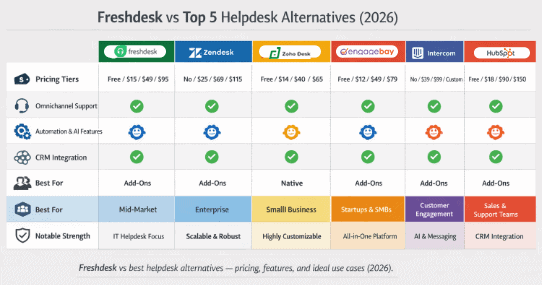
Freshdesk vs best helpdesk alternatives — pricing, features, and ideal use cases (2026).
The 16 Freshdesk alternatives at a glance
|
Tool |
Starting price and billing basis |
Key feature |
G2 rating |
|
EngageBay |
$12.74/month — pricing-team confirmation; billing basis to confirm |
CRM + service + marketing automation |
4.6/5 snapshot |
|
Zendesk |
$55/agent/month — annual Suite Team |
Enterprise-grade ticketing and workflows |
4.3/5 |
|
Zoho Desk |
Free; Express from $7/user/month annual — USD figure to reconfirm |
Self-service and Zia AI |
4.4/5 |
|
Help Scout |
Free; Standard $25/user/month |
Email-first support and shared inbox |
4.4/5 |
|
REVE Chat |
Free; Starter $14.99/month |
AI-first omnichannel engagement |
4.6/5 |
|
LiveAgent |
$15/agent/month — annual |
Ticketing, chat and call center |
4.5/5 |
|
Front |
$19/seat/month — annual; final live-page check |
Shared inbox and collaboration |
4.7/5 |
|
Intercom |
$29/seat/month — annual + $0.99/Fin outcome |
AI-first customer engagement |
4.5/5 |
|
TeamSupport |
$45/month Starter — annual; up to five users |
B2B support collaboration |
4.4/5 |
|
HubSpot Service Hub |
Free; Starter $7/seat/month annual |
CRM-connected service |
4.4/5 |
|
Kustomer |
Custom pricing |
Customer service CRM and omnichannel support |
4.4/5 |
|
Gorgias |
$10/month for 50 tickets |
Ecommerce support |
4.6/5 |
|
Tidio |
Free; Starter $24.17/month |
Live chat and AI automation |
4.6/5 |
|
Jira Service Management |
Free for up to 3 agents; Standard $20/agent/month |
IT service management |
4.3/5 |
|
Salesforce Service Cloud |
Starter Suite $25/user/month |
Enterprise CRM and service |
4.4/5 |
|
Hiver |
Growth $25/user/month annual |
Gmail/Outlook shared inbox support |
4.6/5 |
1. EngageBay
Best for small businesses that want customer support, CRM, sales and marketing in one platform
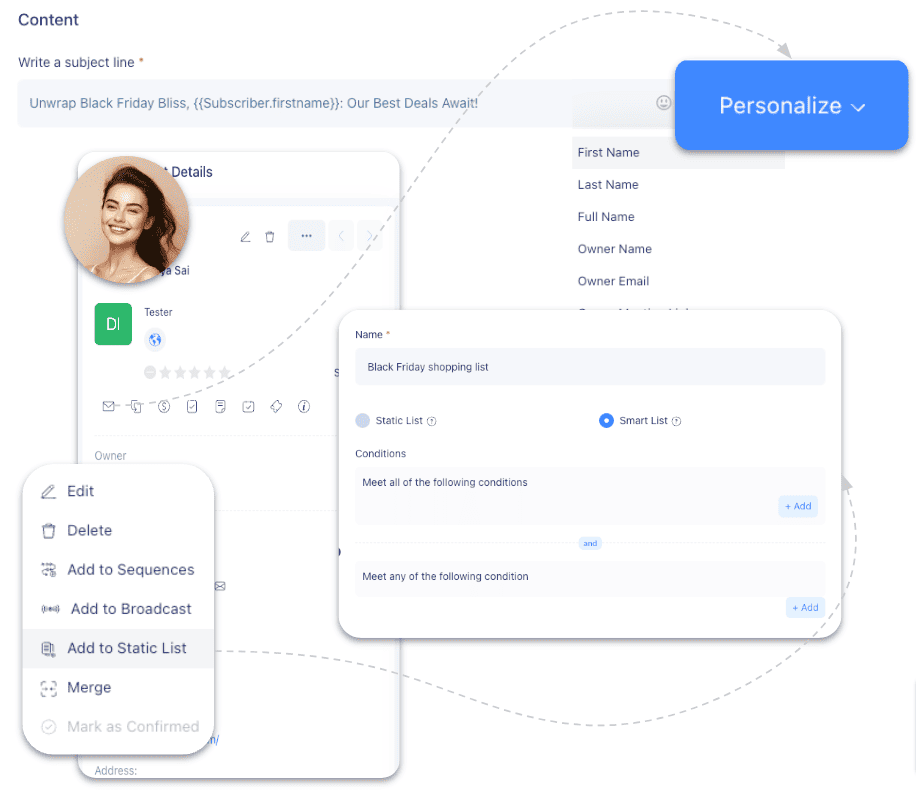
EngageBay is an all-in-one platform that brings customer service together with CRM, sales and marketing.
That makes it different from a pure helpdesk: the support team can work with customer information and the broader customer journey without necessarily adding another CRM product.
For service teams, the important capabilities include helpdesk ticket management, live chat, customer records, automation and a 360-degree view of customer information.
The platform also supports integrations across communications, payments and business applications.
The strongest reason to consider EngageBay as a Freshdesk alternative is consolidation.
A small business that needs support but also needs CRM and marketing automation may prefer one connected platform to several separate subscriptions.
Who it is best for: startups and small businesses that want service, CRM, sales and marketing together.
Who should skip it: organizations looking for a highly specialized enterprise service desk with the deepest possible governance, ITSM or contact-center controls.
Pros:
• Broader customer platform than a standalone helpdesk.
• Free helpdesk and live chat options are available.
• Customer context can be used by service teams.
• Can reduce the number of separate tools a growing business needs.
Cons:
• Enterprise-grade support operations may require capabilities beyond the core small-business focus.
• Advanced requirements should be tested during a trial before a large migration.
2. Zendesk
Best for larger support teams that need deep ticketing, routing and ecosystem breadth
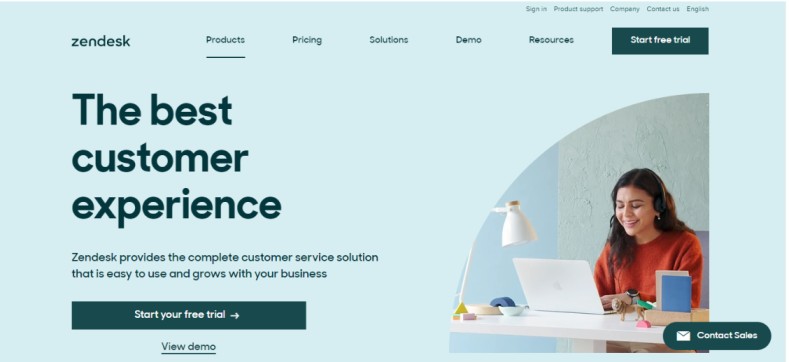
Zendesk remains one of the closest like-for-like alternatives to Freshdesk.
Its strength is depth: ticketing, messaging, email, voice, reporting, workflows and a large marketplace make it suitable for support organizations that have moved beyond simple shared inbox management.
Current Suite plans include a unified agent workspace, ticketing, messaging across web, mobile and social channels, email, voice and live chat, reporting and access to marketplace apps.
Zendesk also has a growing set of AI capabilities, including AI agents and advanced AI options.
As of October 2026, the public Suite pricing structure lists Suite Team at $55 per agent per month billed annually, Suite Growth at $89 per agent per month, and Suite Professional at $115 per agent per month.
Enterprise-level packages are custom-priced. Do not describe Suite Team as a five-agent package: $55 is the price per agent.
Zendesk can be a strong choice if you need sophisticated routing, reporting and administration.
The trade-off is cost and complexity. Smaller teams may find that they are paying for capabilities they do not yet need.
Who it is best for: mid-market and enterprise support teams with complex workflows.
Who should skip it: very small teams that mainly need a simple shared inbox at the lowest possible cost.
Pros:
• Deep ticketing and workflow capabilities.
• Broad integrations and support channels.
• Strong fit for complex support operations.
Cons:
• Higher starting cost than many SMB-focused options.
• Configuration can require more administration.
3. Zoho Desk
Best for budget-conscious teams, especially those already using Zoho
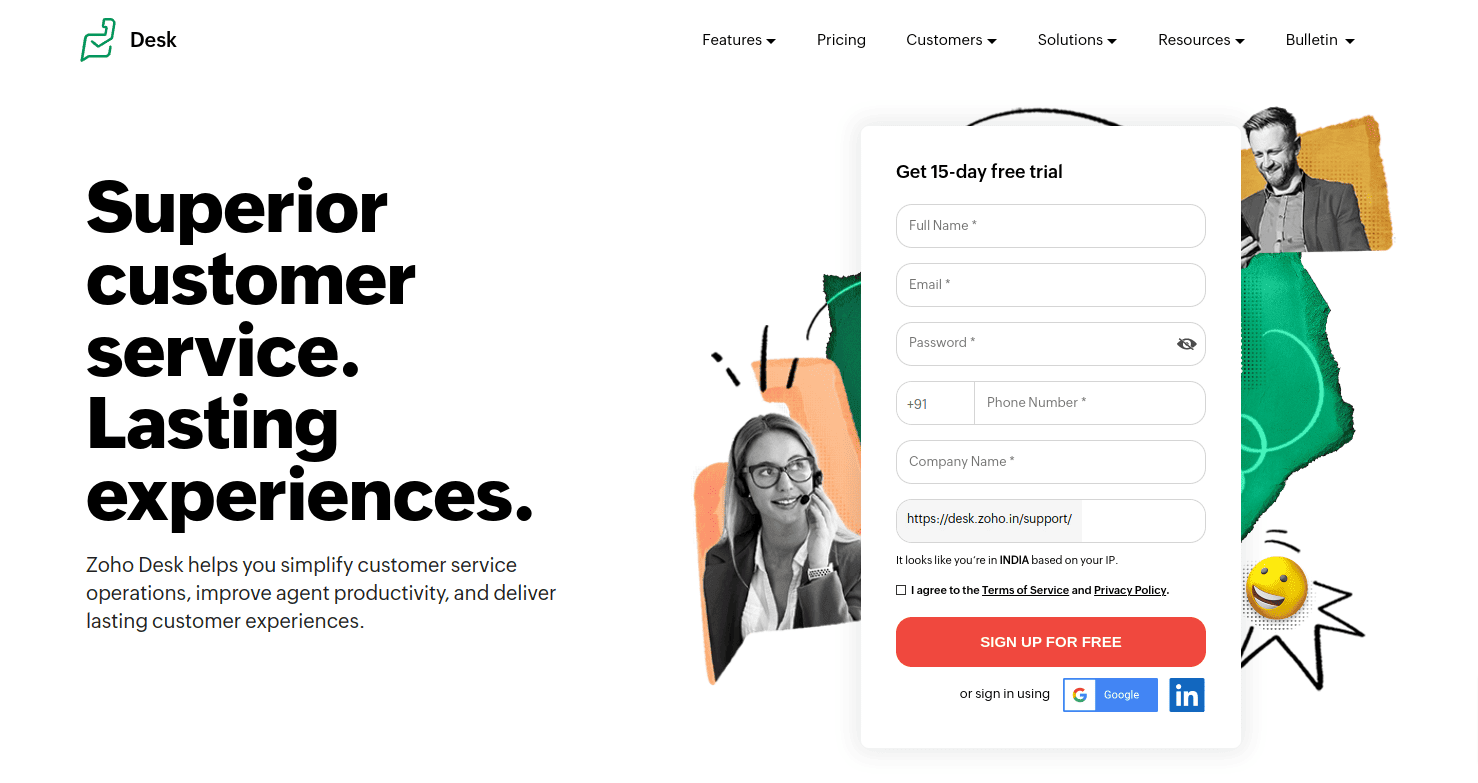
Zoho Desk is one of the most direct Freshdesk alternatives for teams that want a conventional helpdesk at a lower entry point.
It combines ticketing, self-service, automation, reporting and AI features with the broader Zoho ecosystem.
The current Zoho Desk structure includes a Free Edition for three user licenses, followed by Express, Standard, Professional and Enterprise editions.
Feature progression is straightforward. Express covers core email and social support, web forms, workflows, direct assignment and escalation.
Standard adds business messaging, instant messaging, knowledge-base and customer-happiness capabilities.
Professional adds telephony, Zia AI, blueprints, multiple departments and advanced routing. Enterprise adds capabilities such as guided conversations, skill-based assignment, multi-brand help centers and sandbox environments.
Who it is best for: small and mid-sized businesses that want strong value and may already use Zoho CRM or other Zoho applications.
Who should skip it: teams that want an extremely simple interface with minimal configuration or teams that need a highly specialized enterprise service platform.
Pros:
• Free Edition for three users.
• Broad feature progression.
• Strong Zoho ecosystem integration.
• Zia AI and automation at higher tiers.
Cons:
• The number of settings and options can make configuration feel busy.
• Exact cost should be calculated using your team size and selected edition.
4. Help Scout
Best for small teams that want a simple, email-first support experience
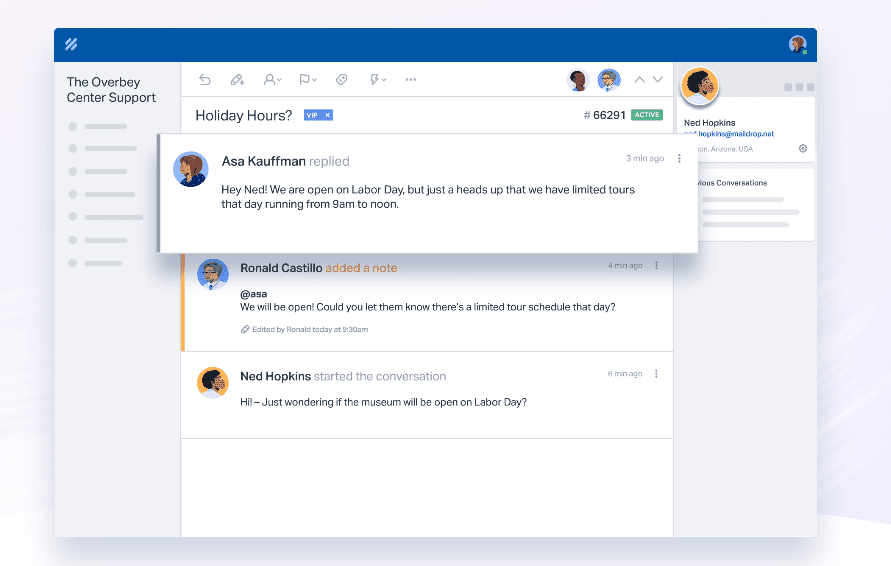
Help Scout takes a more conversational approach to customer support than a traditional ticket-heavy service desk.
It is particularly attractive to small teams that want shared inboxes, email support, live chat and knowledge-base capabilities without building a complicated service operation.
The current pricing structure has four packages. Free supports up to five users.
Standard is $25 per user per month, Plus is $45 per user per month, and Pro is $75 per user per month.
Help Scout’s current plan comparison also distinguishes inbox, user, contact and light-user limits, so those should not be mixed together in one sentence.
The current Standard plan includes multiple inboxes, live chat and SMS, WhatsApp, Instagram and Messenger, multiple knowledge bases, workflows and an AI inbox assistant.
Plus adds advanced workflows, additional SLA capabilities, routing and integrations with tools such as Salesforce, Jira and HubSpot. Pro is aimed at larger teams with greater scale and security requirements.
Who it is best for: small and mid-sized teams that primarily support customers through email and conversational channels.
Who should skip it: teams that need the deepest ITSM, enterprise governance or highly complex ticket routing.
Pros:
• Clear, approachable support experience.
• Free plan for up to five users.
• Strong shared inbox and knowledge-base approach.
• AI assistance is increasingly built into the product.
Cons:
• Advanced capabilities sit on higher tiers.
• Larger, complex operations may need a more specialized platform.
5. REVE Chat
Best for teams that want AI-first live engagement across multiple channels
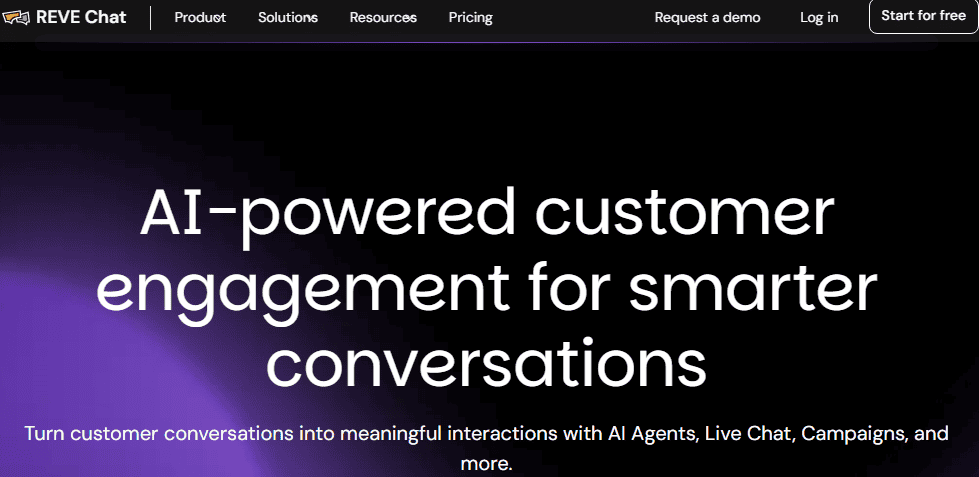
REVE Chat is an omnichannel customer engagement platform with live chat, AI agents, chatbot capabilities, ticketing and proactive campaigns.
It is particularly relevant if your support strategy includes website chat and messaging channels rather than email tickets alone.
Its current pricing model changed in September 2026. The Free plan includes one seat and 10 AI conversations per month. Starter begins at $14.99 per month and includes one seat and 50 AI conversations per month. Growth starts at $59.99 per month with three seats and 250 AI conversations per month. Enterprise starts at $291.99 per month with 10 seats and 1,000 AI conversations per month. Additional seats and AI conversations can add to the bill.
The new model is based on AI Conversations, so readers should compare expected conversation volume rather than simply comparing subscription prices.
REVE Chat also supports channels and integrations such as website, Facebook, Instagram, WhatsApp, email, Shopify and WooCommerce depending on the plan.
Who it is best for: businesses that want live chat, messaging and AI engagement in one system.
Who should skip it: teams looking primarily for a classic email-first helpdesk with the simplest possible pricing.
Pros:
• Strong omnichannel engagement.
• AI agent and chatbot capabilities.
• Ticketing connected to conversational support.
• Useful for ecommerce and messaging-led support.
Cons:
• Usage-based AI economics need careful planning.
• The product can feel broad for a very small support requirement.
Read also: 25+ Brilliant Small Business Tools for the Internet Champion
6. LiveAgent
Best for businesses that need ticketing, live chat and call-center functionality
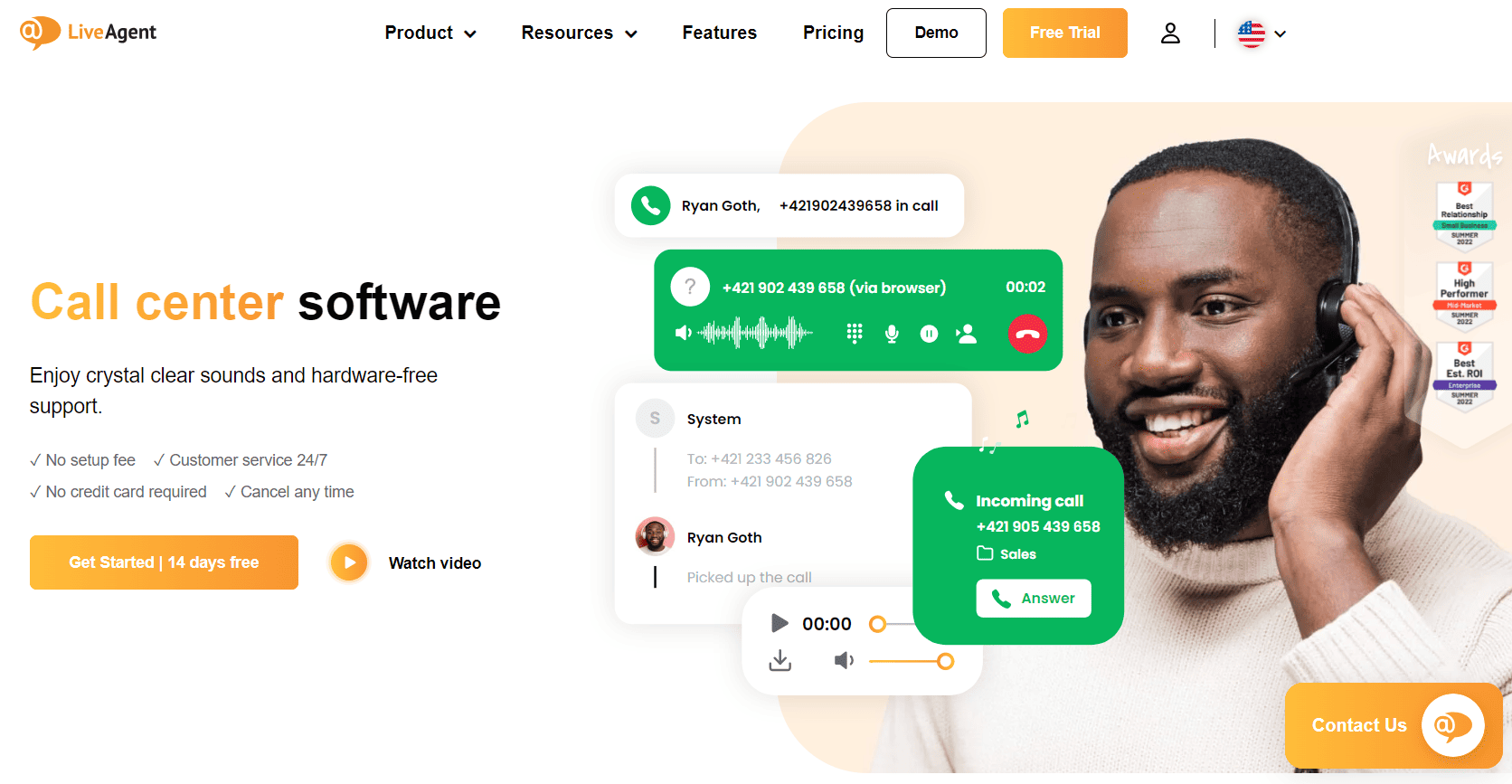
LiveAgent is a broad customer support platform built around ticketing, live chat, knowledge bases and call-center capabilities.
It is a good option for teams that want more channels than a basic email helpdesk provides without immediately moving to an enterprise platform.
The current annual pricing is $15 per agent per month for Small Business, $29 for Medium Business, $49 for Large Business and $69 for Enterprise. Monthly pricing is higher.
The entry plan includes ticketing, live chat, knowledge base, customer portal, contact forms, automation rules and integrations. Higher plans add call center and IVR capabilities, more reporting, SLA features, custom roles, social channels and additional collaboration controls.
Who it is best for: small and mid-sized teams that need several customer-service channels and want predictable per-agent pricing.
Who should skip it: teams looking for the most modern AI-first customer engagement experience or the simplest possible interface.
Pros:
• Strong combination of ticketing, chat and voice.
• Clear annual per-agent pricing.
• Broad channel coverage.
• Useful for teams that need a call center.
Cons:
• Some teams may find the interface less modern than newer competitors.
• Higher plans are needed for deeper governance and advanced features.
7. Front
Best for teams that manage customer operations through shared inboxes
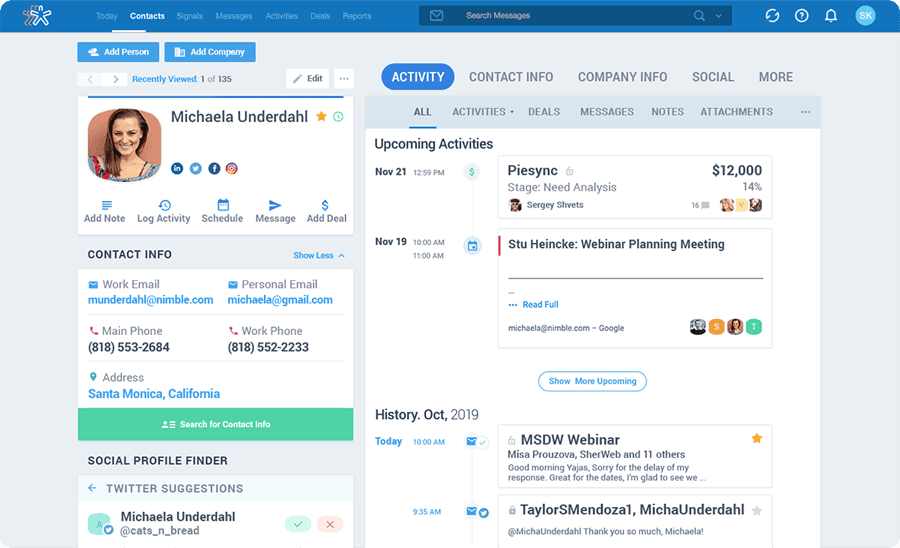
Front is built around the idea that customer operations often happen in shared inboxes rather than traditional ticket queues.
It combines email, collaboration, automation and omnichannel messaging so teams can work together while keeping ownership clear.
Front’s published plan structure includes Starter, Growth, Scale and Premier. Starter has historically been positioned at $19 per seat per month with annual billing and a 2–10 seat range; Growth at $59 with a five-seat minimum; Scale at $99 with a 20-seat minimum; and Premier at $229 with a 50-seat minimum.
Front is particularly useful when support overlaps with sales, operations or account management. Shared inboxes, collaboration, automation, rules and analytics make it easier to coordinate work without forwarding emails between departments.
Who it is best for: email-heavy teams where collaboration and ownership are more important than a classic helpdesk experience.
Who should skip it: teams that need a highly specialized IT service desk or a very deep traditional ticketing system.
Pros:
• Excellent shared-inbox model.
• Strong collaboration and workflow automation.
• Good fit for cross-functional customer operations.
Cons:
• Cost rises as seats and capabilities increase.
• Add-ons and usage can increase total cost.
8. Intercom
Best for SaaS and digital-first teams that want AI-led customer engagement
Intercom has evolved from a messaging product into a broader customer service platform centered on AI and proactive engagement.
Its main differentiator is Fin, the AI Agent, which works alongside human support rather than treating AI as a separate chatbot.
The current public pricing page lists Essential at $29 per seat per month, Advanced at $85 per seat per month and a higher Expert tier.
The important pricing detail is that Fin is separate from the seat subscription: Intercom currently lists Fin from $0.99 per outcome.
Essential includes Fin, Messenger, shared inbox, ticketing, reporting, a public help center and basic automation. Advanced adds deeper workflow automation, multiple team inboxes, round-robin assignment and additional help-center capabilities.
Who it is best for: SaaS, technology and digital-first businesses where chat, in-app engagement and AI resolution are central.
Who should skip it: teams that need a basic low-cost email helpdesk or want pricing that does not vary with AI outcomes.
Pros:
• Strong AI and proactive messaging.
• Modern customer engagement experience.
• Good fit for in-app and conversational support.
Cons:
• Seat pricing plus AI outcome pricing makes total cost harder to predict.
• Advanced workflow capabilities require higher plans.
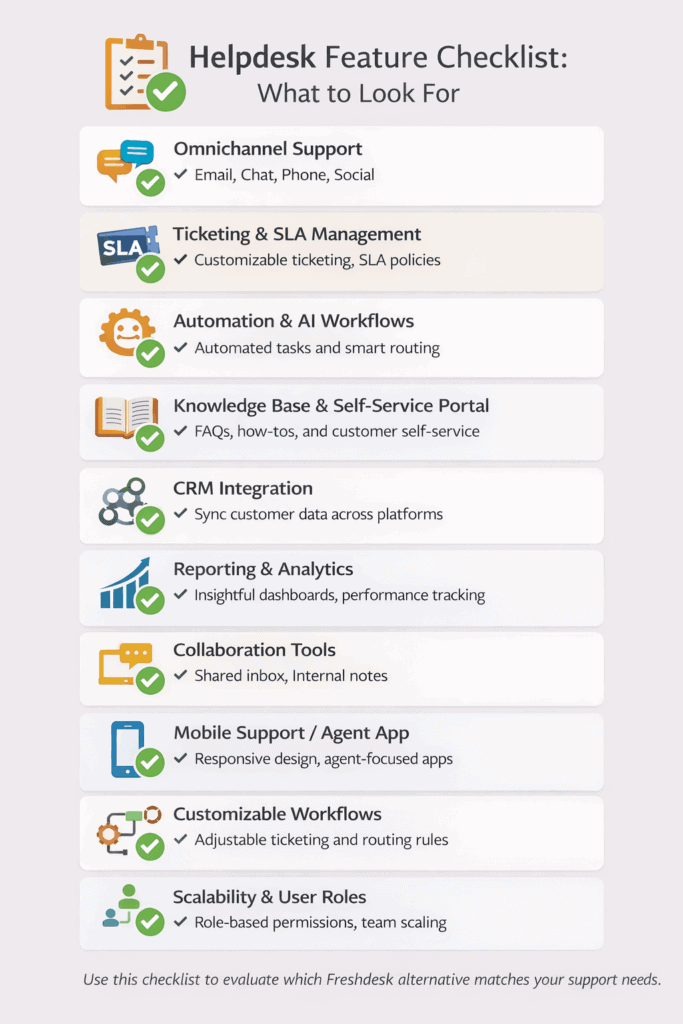
Use this checklist to evaluate which Freshdesk alternative matches your support needs.
9. TeamSupport
Best for B2B support teams that need collaboration and customer context
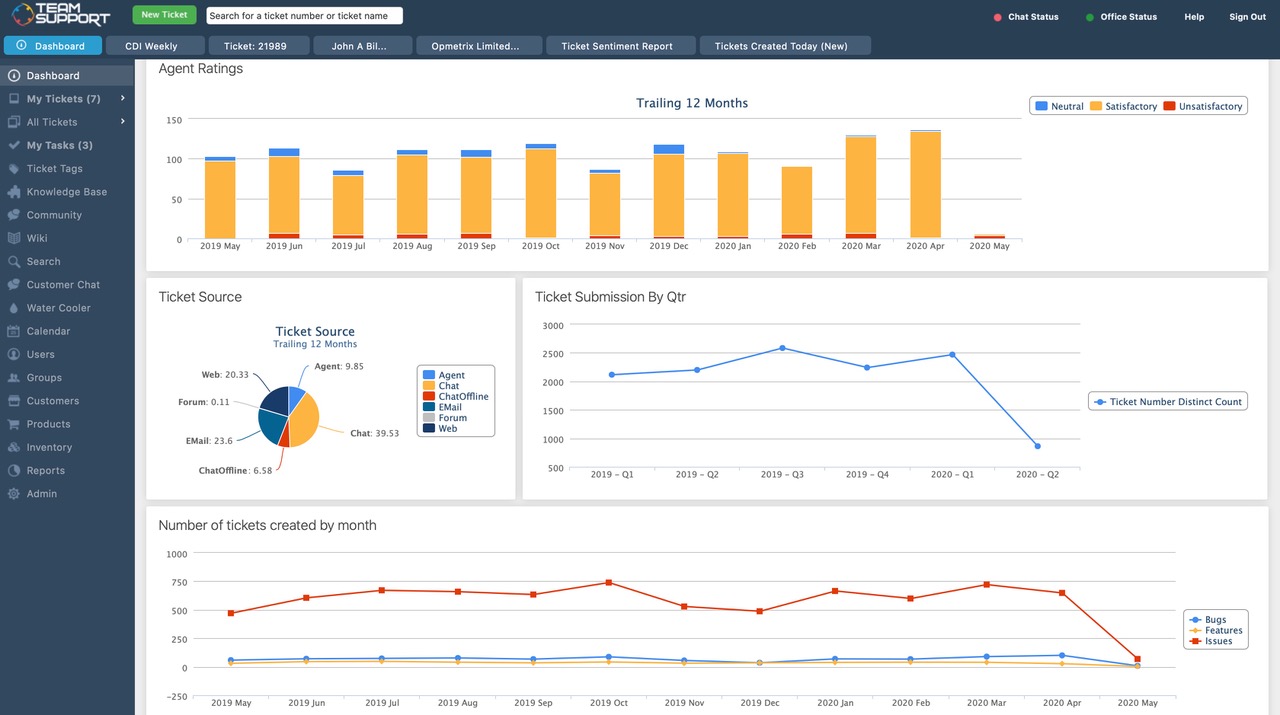
TeamSupport is focused on B2B customer support and collaboration.
It combines ticketing with customer information, messaging, reporting and AI productivity tools. That makes it a useful alternative when the support team needs visibility into customer relationships rather than simply processing incoming tickets.
The current Starter plan is $45 per month billed annually and supports up to five users. Professional is $65 per month and Scale is $85 per month. Messaging and live chat are shown as separate per-agent pricing, so the old $29 Chat Support figure is not the platform’s current entry price.
TeamSupport also offers customer intelligence, customer portals, playbooks, knowledge-base features, automation and AI productivity capabilities at higher tiers.
Who it is best for: B2B companies where support, customer health and internal collaboration overlap.
Who should skip it: very small teams looking for the cheapest possible helpdesk or companies that need a broad ecommerce-focused support stack.
Pros:
• Strong B2B orientation.
• Customer context and collaboration.
• AI productivity features.
• Higher tiers add automation and reporting.
Cons:
• Current pricing has several components.
• The product is more specialized than a general-purpose helpdesk.
10. HubSpot Service Hub
Best for teams already invested in the HubSpot CRM ecosystem
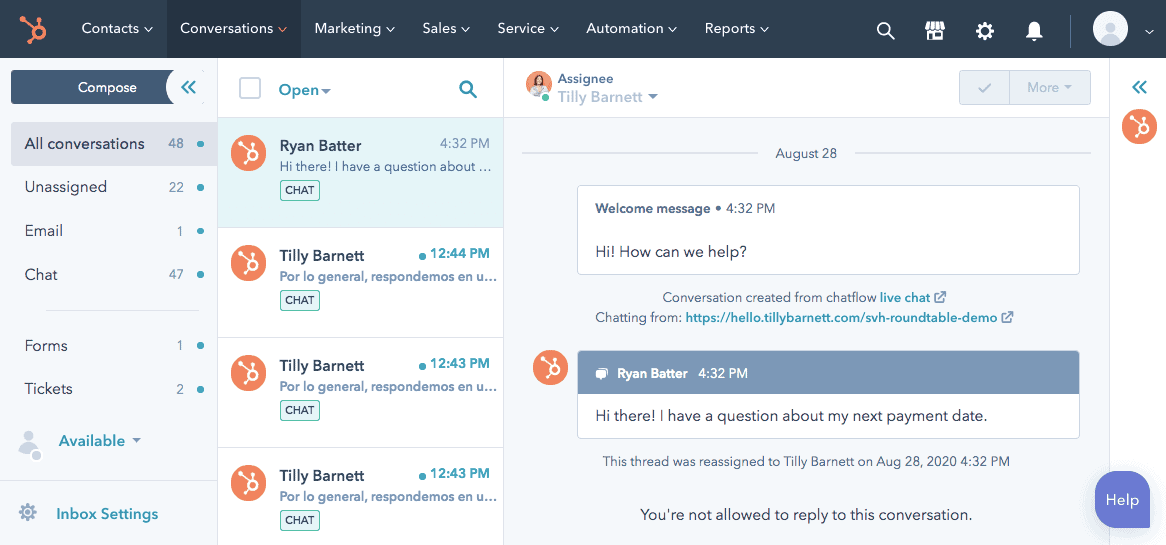
HubSpot Service Hub is a natural Freshdesk alternative when customer service needs to share data with sales, marketing and CRM workflows.
Instead of maintaining support as a separate island, teams can keep customer records and service activity in the wider HubSpot platform.
As of October 2026, the public Service Hub pricing page shows Free for up to two users, Starter from $7 per seat per month, Professional from $90 per seat per month, and Enterprise from $150 per seat per month. Professional also has a required one-time $1,500 onboarding fee, while Enterprise has a required one-time $3,500 onboarding fee.
Service Hub includes ticketing, shared inbox, live chat and customer management in the free and lower tiers. Professional adds deeper helpdesk, customer portal, knowledge base and automation capabilities. Enterprise adds more advanced routing, governance and analytics.
Who it is best for: businesses already using HubSpot CRM or teams that want service, sales and marketing connected.
Who should skip it: teams that only need a simple helpdesk and do not want to pay for a broader CRM ecosystem.
Pros:
• Strong CRM context.
• Good integration with HubSpot sales and marketing.
• Free entry option.
• Powerful higher-tier automation.
Cons:
• Professional and Enterprise have significant onboarding costs.
• Advanced service capabilities become expensive as seat count grows.
11. Kustomer
Best for customer-service operations that want CRM and omnichannel support together
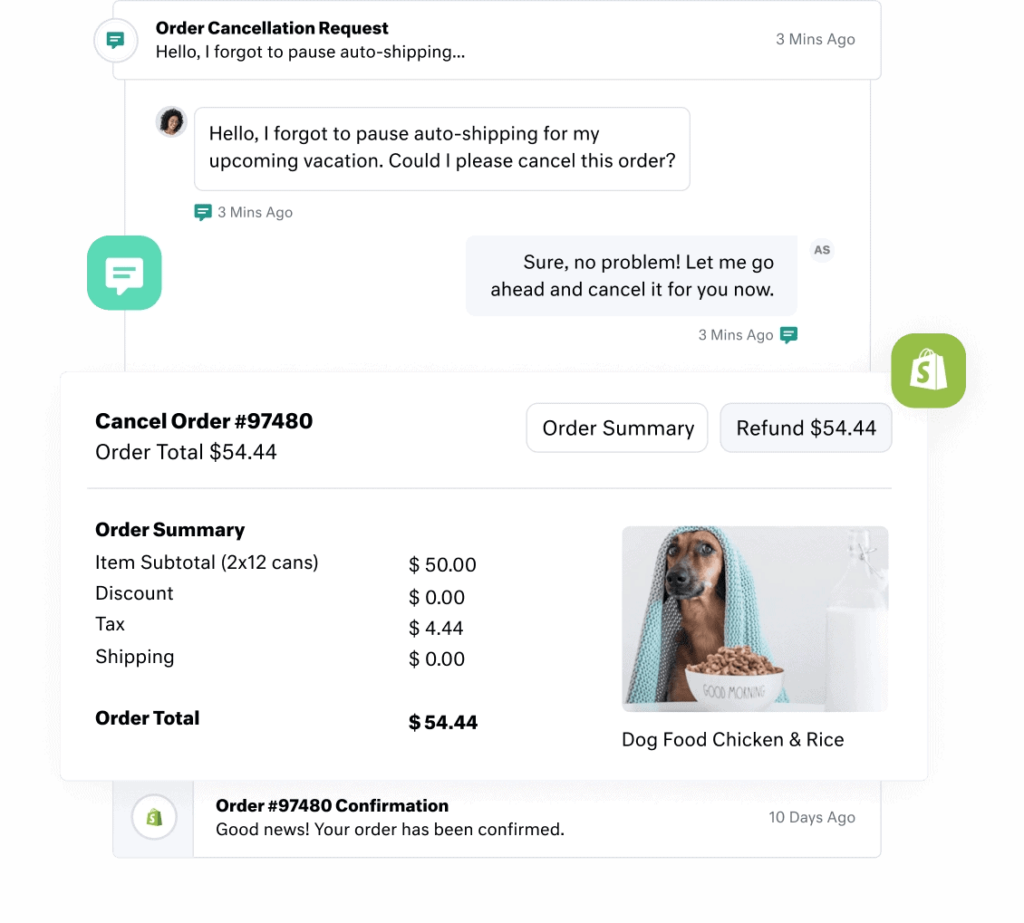
Kustomer is a customer service CRM designed around a unified customer timeline and omnichannel interactions.
It is a particularly relevant alternative for businesses where support agents need to understand the customer’s full relationship with the company rather than only the current ticket.
The live Kustomer pricing page no longer publishes the old public Enterprise and Ultimate price grid. Instead, Kustomer asks prospective customers to complete an assessment and then provides tailored pricing.
Kustomer’s strengths include customer profiles, conversation history, omnichannel support, automation, self-service and AI-driven workflows. It can be a strong fit for larger customer-service organizations that want a CRM-style service experience.
Who it is best for: established customer-service operations with complex customer journeys.
Who should skip it: small businesses looking for a simple public-price helpdesk.
Pros:
• Customer-service CRM approach.
• Omnichannel support.
• Strong customer context and workflow potential.
Cons:
• Public pricing is not transparent enough for a simple price comparison.
• It may be more platform than a small support team needs.
12. Gorgias
Best for ecommerce brands, especially Shopify-focused teams

Gorgias is built around ecommerce customer service.
Its advantage is not merely ticket management; it connects customer conversations with order and store information so agents can solve questions about products, orders, returns and refunds without switching constantly between systems.
Gorgias uses ticket-based pricing rather than charging primarily by agent seats. Its current 2026 plan guide lists Starter at $10 per month for 50 billable tickets, Basic at $60 for 300 tickets, Pro at $360 for 2,000 tickets, Advanced at $900 for 5,000 tickets, and Enterprise at custom pricing.
This pricing model can be attractive for teams with many agents but predictable support volume. The opposite is also true: a business with rapidly growing ticket volume should calculate its expected monthly cost before choosing a plan.
Gorgias also charges separately for its AI Agent on an outcome basis. Voice and SMS are available as paid additions.
Who it is best for: ecommerce and direct-to-consumer brands.
Who should skip it: businesses that need a general-purpose helpdesk rather than ecommerce-native workflows.
Pros:
• Strong Shopify and ecommerce context.
• Ticket-volume pricing rather than conventional per-agent pricing.
• Automation and AI can reduce repetitive work.
Cons:
• Costs rise with support volume.
• Less compelling for non-ecommerce businesses.
13. Tidio
Best for small businesses that want live chat and AI automation
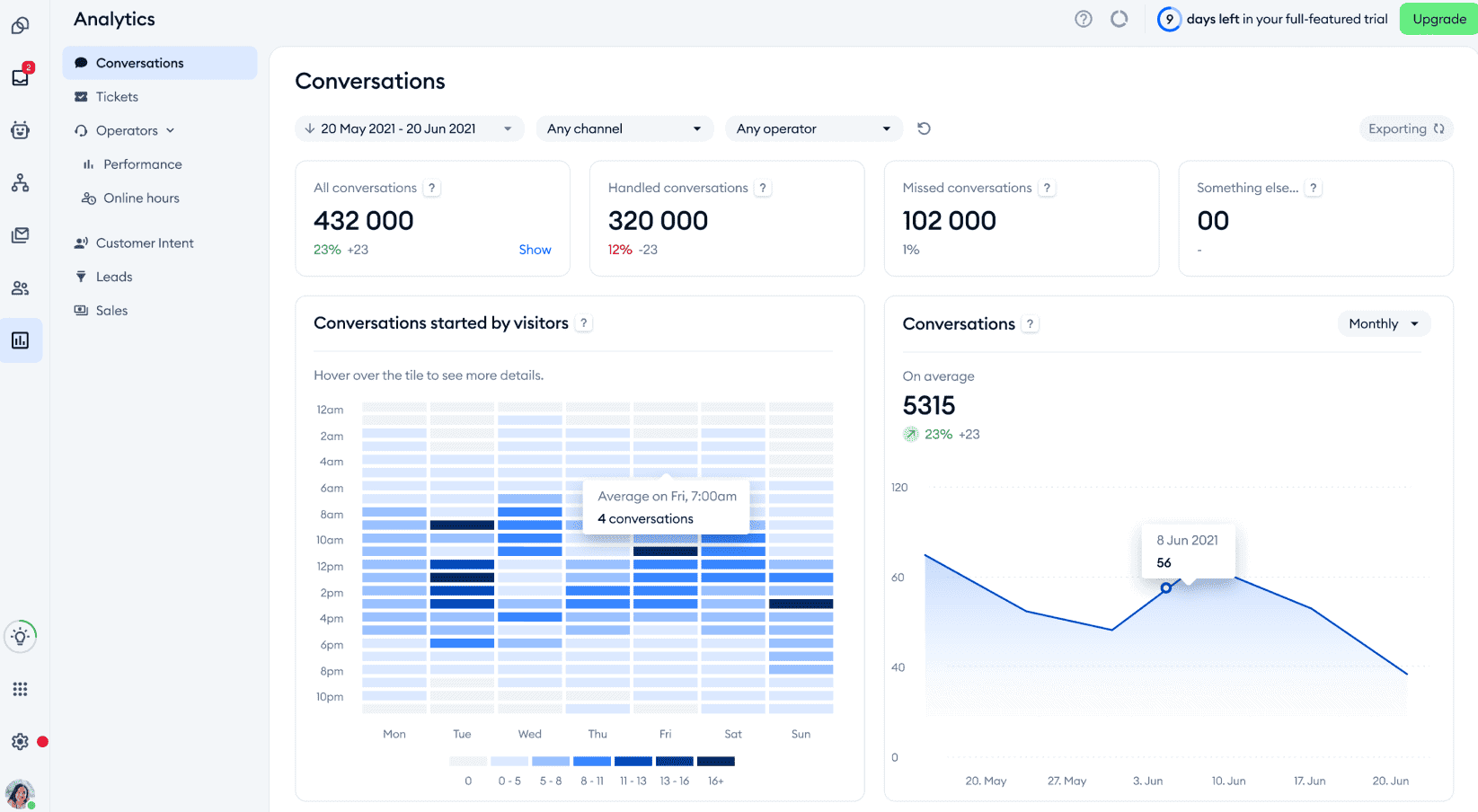
Tidio combines live chat, chatbot automation, customer support and AI through products such as Lyro. It is designed for businesses that want to engage website visitors and automate common questions without deploying a large service operation.
The current pricing page lists Free, Starter, Growth, Plus and Premium. Starter is currently $24.17 per month, Growth starts at $49.17 per month, Plus starts at $300 per month plus monthly usage, and Premium is custom-priced. The current page also allows businesses to adjust quotas for billable conversations, Lyro AI conversations and visitors reached with Flows.
That means Tidio should not be compared solely on the subscription headline. A business with high conversation volume or heavy AI usage should model the usage quotas before choosing a plan.
Who it is best for: small businesses that rely heavily on website chat and automated customer engagement.
Who should skip it: teams that need a sophisticated traditional ticketing system with deep enterprise governance.
Pros:
• Easy entry point.
• Strong live-chat experience.
• Lyro AI and automation capabilities.
• Useful for website-led customer engagement.
Cons:
• Usage quotas can affect total cost.
• Advanced plans can become expensive for high-volume operations.
14. Jira Service Management
Best for IT, internal service and technical support teams
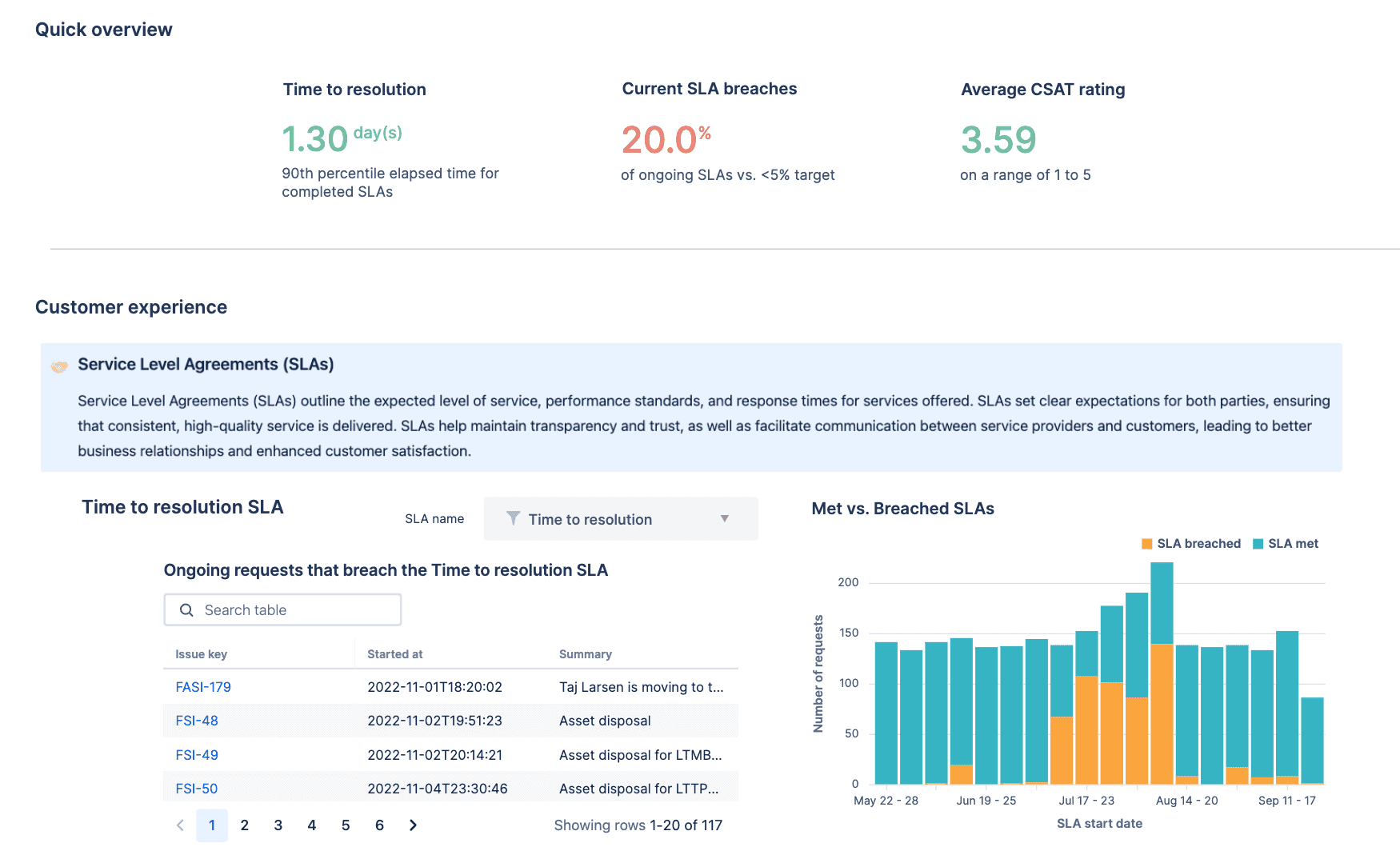
Jira Service Management is the strongest specialist option in this list for IT and technical service operations.
It is built around service management rather than only customer email support, so it is especially useful when you need incident, problem, change, asset and service workflows.
Atlassian’s current Service Collection pricing shows Free forever for up to three agents, Standard at $20 per agent per month, Premium at $51.42 per agent per month and Enterprise with custom pricing. The current product also includes Rovo capabilities and AI-powered service features, with Premium adding virtual service agents, advanced incident management and other higher-level capabilities.
The platform is closely connected to the Atlassian ecosystem and is a strong choice for teams already using Jira, Confluence or related Atlassian products.
Who it is best for: IT service desks, internal support teams, technical operations and organizations with structured incident and change processes.
Who should skip it: a small customer-service team that only needs email ticketing and a simple knowledge base.
Pros:
• Excellent IT service-management capabilities.
• Strong automation and workflows.
• Deep Atlassian ecosystem.
• Free tier for up to three agents.
Cons:
• More complex than a basic customer helpdesk.
• Customer-service-only teams may find ITSM features unnecessary.
15. Salesforce Service Cloud
Best for enterprises that need service inside the Salesforce ecosystem
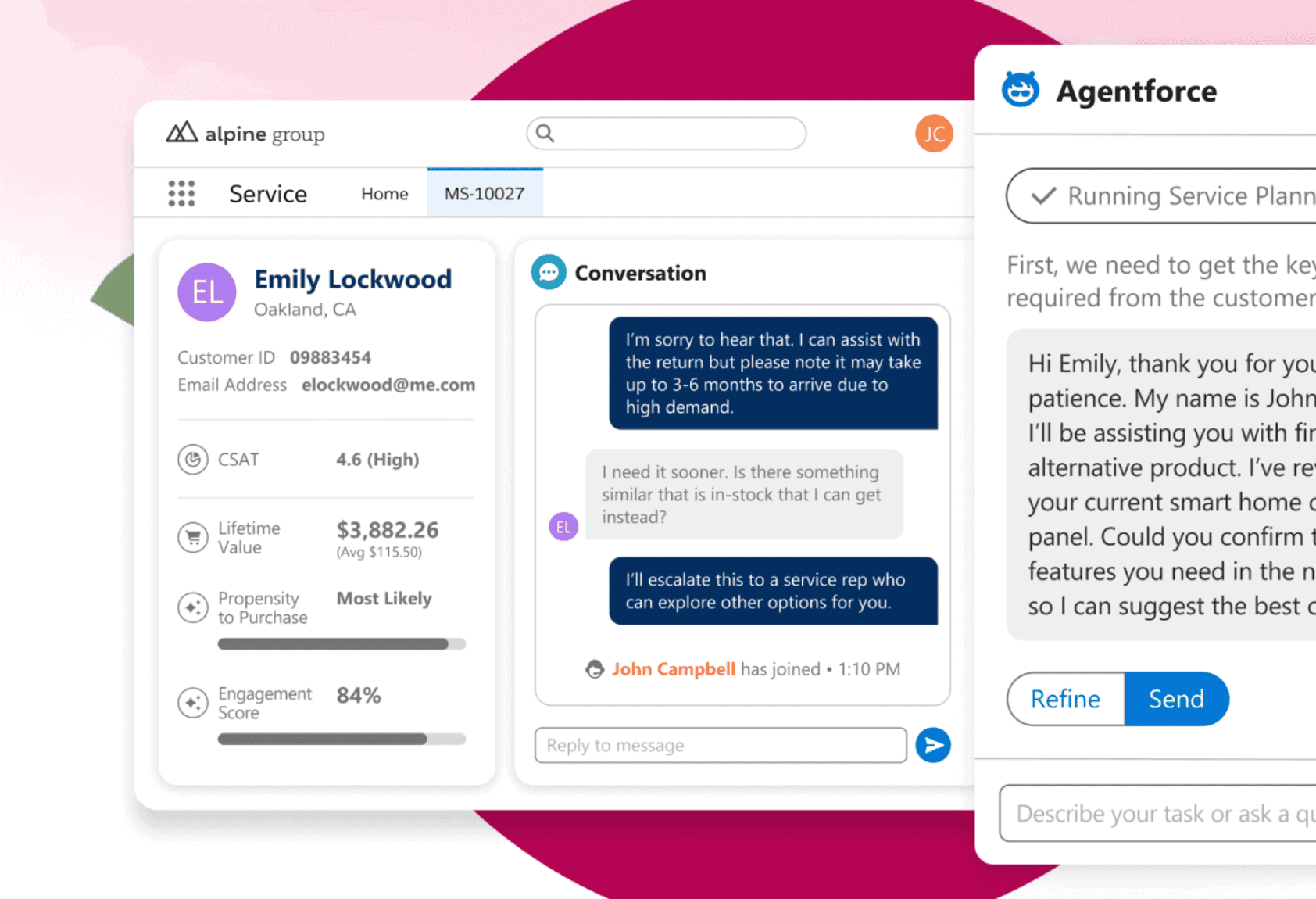
Salesforce Service Cloud is aimed at organizations that want customer service connected to Salesforce CRM, data and enterprise workflows.
It is one of the strongest choices in this list for organizations with complex customer journeys and substantial administrative requirements.
Salesforce’s public Service Cloud pages currently show Starter Suite at $25 per user per month, while other current pricing surfaces present Core, Advanced and Max editions at substantially higher prices.
Salesforce also promotes Agentforce 1 Service as a broader AI-powered service offering.
The key feature is ecosystem depth. Salesforce connects service with CRM records, workflows, knowledge, channels and AI. That can be extremely valuable for a large organization but unnecessarily complex for a small support team.
Who it is best for: enterprise organizations already invested in Salesforce.
Who should skip it: startups and small businesses looking for an inexpensive, easy-to-configure helpdesk.
Pros:
• Deep CRM and service integration.
• Strong omnichannel capabilities.
• Enterprise scalability.
• Extensive customization and AI options.
Cons:
• High total cost at advanced tiers.
• Implementation and administration can be demanding.
16. Hiver
Best for teams that want a helpdesk inside Gmail or Outlook
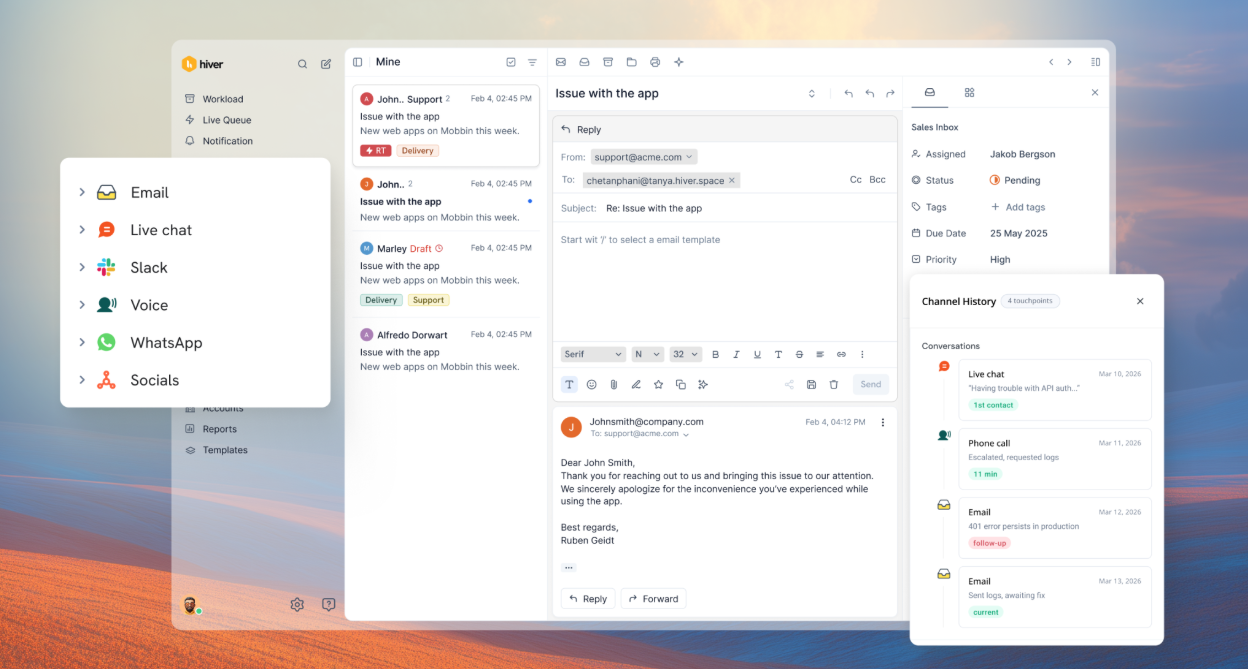
Hiver is designed for businesses that want structured customer support without moving away from the email environment they already use.
Shared inboxes such as support@ and help@ can be managed with ownership, internal notes, collaboration, automation and ticket tracking.
Hiver’s current pricing materials show a free entry experience in some product configurations and a Growth plan at $25 per user per month billed annually.
Other current Hiver materials show Pro and Elite tiers around $55 and $85 per user per month, respectively.
Hiver’s AI capabilities include tools for drafting and summarizing conversations, AI agents and AI copilots depending on plan. It also offers workflows, analytics, SLAs, CSAT and additional channels at higher levels.
Who it is best for: teams already operating from Gmail or Outlook that want helpdesk structure without adopting a completely separate support interface.
Who should skip it: organizations that need a highly specialized standalone enterprise service platform.
Pros:
• Familiar email-centered workflow.
• Strong shared inbox and collaboration.
• Useful automation and AI.
• Good fit for small and mid-sized teams.
Cons:
• Advanced AI and omnichannel capabilities are concentrated on higher plans.
• Inbox-first teams may still need a separate system for complex enterprise service management.
How to switch from Freshdesk
A migration does not have to be disruptive, but it should be treated as a project rather than a simple software swap. The safest approach is to map the information you need before you cancel the old platform.
-
- Define the reason for switching. Write down the specific problems you want the new platform to solve: cost, AI, usability, CRM integration, reporting, channels or workflow limitations.
- Inventory your current Freshdesk data. Include agents, contacts, companies, tickets, ticket fields, tags, statuses, attachments, canned responses, automations, SLAs and knowledge-base articles.
- Separate must-have data from historical data. Not every old record needs to be migrated into the active workspace.
- Choose the new platform and confirm the exact plan. Make sure the plan supports your agent count, ticket volume, integrations and AI requirements.
- Map your workflows. Recreate routing, escalation, SLA, notification and automation rules before moving live traffic.
- Prepare the knowledge base. Clean outdated articles and update screenshots before importing or rebuilding them.
- Test with a small group. Have several agents use the new system on real examples and record anything that slows them down.
- Run a controlled migration. Import the data you need, verify records and attachments, and check that customer identities and ticket histories are correctly associated.
- Move channels gradually. Start with one support mailbox or a limited channel before moving every customer at once.
- Keep Freshdesk available during the transition. Do not close the old account until the new platform has been tested and the required historical data has been verified.
- Measure the first 30 days. Track first-response time, resolution time, backlog, CSAT, automation rate and support cost per conversation.
The best migration is the one customers barely notice. If the new platform makes agents work harder or causes customers to repeat information, the software change has not solved the underlying problem.
Freshdesk alternatives by use case
For small businesses, start with EngageBay, Zoho Desk or Help Scout and compare the free or entry tiers against your actual team size.
For ecommerce, Gorgias is worth serious consideration because order information and customer conversations are designed to work together.
For IT, Jira Service Management is more appropriate than a general customer helpdesk when incidents, changes and assets are central to the operation.
For AI-first customer engagement, Intercom and REVE Chat deserve attention because their products are designed around AI and conversational support.
For teams living in Gmail or Outlook, Hiver can be easier to adopt than a separate helpdesk interface. For enterprise organizations, Zendesk, HubSpot Service Hub and Salesforce Service Cloud provide deeper ecosystems and administrative controls, although their total costs can be much higher.
There is no universal winner. The best Freshdesk alternative is the one whose pricing model, workflows, channels and level of complexity match the way your team actually supports customers.
Wrap Up
Freshdesk remains a capable customer support platform, but today’s helpdesk market gives businesses more choices than ever.
The most important change is that comparing headline subscription prices is no longer enough. AI usage, seats, tickets, contacts, onboarding and add-ons can materially change what you pay.
If you are a small business, focus on usability and total cost rather than buying the longest feature list.
If you are an ecommerce brand, prioritize customer and order context.
If you run IT service operations, choose a platform built around service management.
If you already use a CRM such as HubSpot or Salesforce, the value of keeping service data in the same ecosystem may outweigh the appeal of a standalone helpdesk.
EngageBay is one option for businesses that want customer support connected with CRM, sales and marketing capabilities. The best way to evaluate it is to test your own support workflows and confirm the current pricing with the EngageBay team before making a decision.
EngageBay scales with your business, so it’s easier to grow. Try it free today and see for yourself if this is what you were looking for 🙂
The right platform should make your support team faster and your customer experience clearer, not simply add another subscription to manage.
Top Freshdesk alternatives include EngageBay, Zendesk, Zoho Desk, Help Scout, LiveAgent, Intercom, HubSpot Service Hub, TeamSupport, Kustomer, Gorgias, Tidio, Jira Service Management, and Salesforce Service Cloud.
Affordable alternatives like EngageBay, Zoho Desk, Help Scout, and Tidio deliver key helpdesk features with easier setup and pricing that suits small teams.
Yes—EngageBay and Zoho Desk offer free plans with ticketing and basic support features that are ideal for growing support teams without upfront costs.
Evaluate based on support channels (email, chat, phone), automation needs, CRM integrations, scalability, and total cost to find the helpdesk that matches your workflow.
Most modern helpdesk platforms like Zendesk, HubSpot Service Hub, and Zoho Desk offer deep CRM and third-party integrations, helping teams unify support data with sales and marketing systems.
