CRM software (Customer Relationship Management software) is a technology platform that helps businesses manage interactions with current and prospective customers, centralize contact data, track sales pipelines, and automate marketing and support workflows.
Signup now & get a FREE
Free onboarding session worth $1,199



Used by organizations of every size, CRM software acts as a single source of truth for customer data, giving Marketing, Sales, and Support teams the visibility they need to deliver consistent, personalized experiences across every touchpoint.
The global CRM software market surpassed $100 billion in 2025 and continues to grow as businesses recognize that strong customer relationships are the foundation of sustainable revenue.
CRM software is not one-size-fits-all. There are three core categories, each designed to address different business needs:
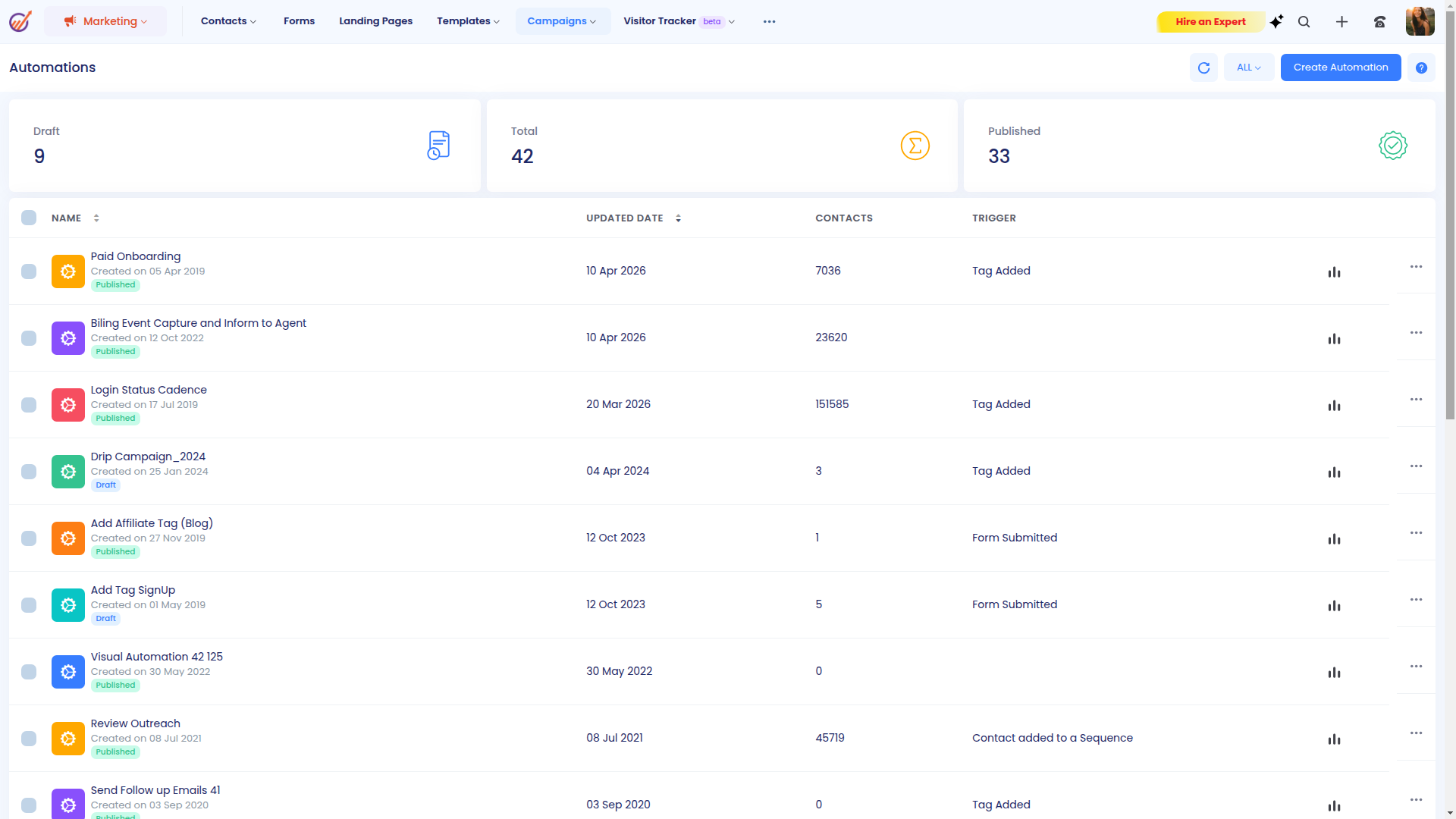
Operational CRM focuses on automating and streamlining customer-facing processes, including sales force automation, marketing automation, and service automation. It helps teams capture leads, manage pipelines, send email sequences, and resolve support tickets without manual overhead. Most SMBs start here.
Analytical CRM is built around data. It collects, stores, and interprets customer interaction data to surface patterns, segment audiences, forecast sales, and improve decision-making. If your team relies on dashboards and reports to guide strategy, analytical CRM features are what you need.
Collaborative CRM facilitates information sharing across departments, ensuring that Marketing, Sales, and Customer Support all have access to the same customer history. It breaks down silos and ensures a seamless handoff between teams throughout the customer lifecycle.
At its core, CRM software works by capturing every interaction a customer has with your business and making that data accessible to everyone who needs it. Here is the typical flow:
A new lead visits your website or fills out a form; the CRM automatically creates a contact record and tags the traffic source.
Every email, call, chat, and meeting is automatically logged against that contact in real time — no manual entry.
The lead moves through a visual sales pipeline, with automated tasks assigned to the right rep at each stage.
Automation sends the right content based on the lead's behavior and lifecycle stage — no manual work required.
When the deal closes, the customer record passes to Support with the full interaction history intact — no context lost.
Dashboards surface which campaigns convert best, which reps close fastest, and where leads are dropping off.
The result is a business that treats every customer as a known individual — not a new face — regardless of which team member they are talking to.
While features vary by platform, the following capabilities are standard across most modern CRM tools:
Centralizes all contact and account records — including communication history, deal status, and behavioral data — in one searchable database.
Gives reps and managers a visual, stage-by-stage view of every open deal, with probability scoring and forecasting built in.
Automates email sequences, drip campaigns, lead nurturing workflows, and follow-ups based on trigger events or time delays.
Assigns a score to each lead based on demographic fit and engagement behavior, helping reps prioritize the highest-value opportunities.
Tracks key metrics — revenue by rep, campaign ROI, churn rate, deal velocity — and visualizes them in real-time dashboards.
Manages inbound support requests, routes them to the right agent, and gives support staff the full customer history needed to resolve issues fast.
Implementing a CRM platform delivers measurable improvements across every revenue-generating function of your business. The most significant benefits include:
Lead capture forms, web tracking, and email sync automatically populate contact records, removing the risk of human error and freeing reps to focus on selling.
With a complete, real-time view of the pipeline, managers can confidently predict revenue based on deal stage, velocity, and historical close rates, rather than gut feel.
CRM software is the connective tissue between departments. Marketing sees which campaigns generated the highest-quality leads. Sales knows which content the lead consumed. Support has the full history before they say hello.
Automated follow-ups, task reminders, and pipeline alerts ensure no deal goes cold through neglect. CRM users consistently close deals significantly faster than teams relying on manual processes.
CRM software makes it easy to track renewal dates, identify at-risk customers based on low engagement, and trigger proactive outreach, reducing churn before it happens.
With rich behavioral and demographic data in one place, marketers can segment audiences precisely and deliver the right message to the right person at the right moment.
A well-implemented CRM grows with you. Whether you have 5 reps or 500, the processes, automation, and reporting stay consistent so your customer experience does not degrade as your team expands.
Simplify your marketing, sales, and support with the best free CRM software
CRM software is not a Sales-only tool. Every customer-facing team gains specific, measurable advantages:
With hundreds of CRM platforms available, narrowing the field requires matching your business stage, team size, and operational complexity to the right solution. Use these criteria:
Criterion 01
A CRM that teams won't adopt is a CRM that delivers no value. Prioritize clean interfaces and short onboarding times.
Criterion 02
All-in-one platforms like EngageBay combine CRM, marketing automation, and helpdesk in a single subscription, avoiding the integration tax of stitching together multiple tools.
Criterion 03
Evaluate whether the platform can automate your most time-consuming workflows: lead assignment, follow-up sequences, deal stage progression, and ticket routing.
Criterion 04
Ensure the platform surfaces the metrics your leadership team actually uses to make decisions — not just vanity dashboards.
Criterion 05
Consider not just the entry price but the cost at scale. Many platforms charge steeply as your contact list or user count grows.
Criterion 06
Always test before you commit. EngageBay offers a free plan for up to 15 users with no credit card required, so you can evaluate the full platform at zero risk.
CRM software is a technology platform that helps businesses manage customer and prospect relationships by centralizing contact data, tracking sales pipelines, automating marketing workflows, and providing analytics across the customer lifecycle.
The three main types are Operational CRM (focused on automating sales, marketing, and service processes), Analytical CRM (focused on interpreting customer data to guide strategy), and Collaborative CRM (focused on sharing customer information across departments to deliver a unified experience).
The primary benefits include reduced manual data entry, more accurate sales forecasting, better team alignment across Marketing, Sales, and Support, faster deal cycles, improved customer retention, smarter audience segmentation, and a scalable operational foundation.
CRM software captures every customer interaction — form submissions, emails, calls, purchases, and support tickets — and stores them against a central contact record. Automation then uses this data to trigger follow-ups, route leads, assign tasks, and generate reports, giving every team member a real-time view of each customer relationship.
CRM pricing ranges from free (EngageBay offers a free plan for up to 15 users) to enterprise tiers costing thousands per month. EngageBay's paid plans start at $12.74/user/month — making it one of the most affordable all-in-one CRM, marketing, and helpdesk platforms available for growing businesses.
No. CRM software is equally valuable for solopreneurs, startups, and SMBs. Modern platforms like EngageBay are specifically designed for small and mid-sized teams, with free plans, affordable pricing, and quick onboarding that requires no technical expertise.
EngageBay is an all-in-one CRM, marketing automation, sales, and helpdesk platform trusted by 135,000+ businesses globally. From email marketing and landing pages to deal pipelines and live chat — all in a single affordable platform, starting at $12.74/user/month.

Install the EngageBay Mobile App



One platform for all your Marketing, Sales, and Support teams.